
Subfamily: Betarhabdovirinae
Genus: Trirhavirus
Distinguishing features
Viruses classified in the genus Trirhavirus have trisegmented genomes and infect dicot hosts – other plant rhabdoviruses have unsegmented or bisegmented genomes. Trirhaviruses form a distinct monophyletic clade in well-supported Maximum Likelihood or Maximum Clade Credibility trees using full-length L sequences which is basal to alpha-, beta- and gammacytorhabdoviruses (Bejerman et al., 2023).
Virion
Morphology
Not known.
Nucleic acid
The negative-sense, single-stranded RNA genome is trisegmented. The 3'- and 5'-termini of the three segments are similar and exhibit partial inverse complementarity. The consensus gene junction sequences of the trisegmented rhabdoviruses are highly similar and like those previously reported for alphacytorhabdoviruses.
Proteins
RNA1 encodes the L protein and; while RNA2 contains four to five ORFs, including the coat protein gene and P2, P3 and P4 proteins of unknown functions. RNA3 has three to four ORFs, in which P6, P7 and P8 are thought to be equivalent to the P, M and G of alpha-, beta-, and gammacytorhabdoviruses (Bejerman et al., 2023). The P5 protein that could be located in RNA2 or RNA3 shows statistically significant similarity to putative silencing suppressor proteins encoded by emaraviruses.
Genome organisation and replication
All trirhaviruses have trisegmented genomes and contain only the L gene in RNA1. RNA2 contains four to five genes in the order 3′-N-2-3-4-5-5′, (Figure 1 Trirhavirus). RNA 3 contains three to four genes (Figure 1 Trirhavirus).
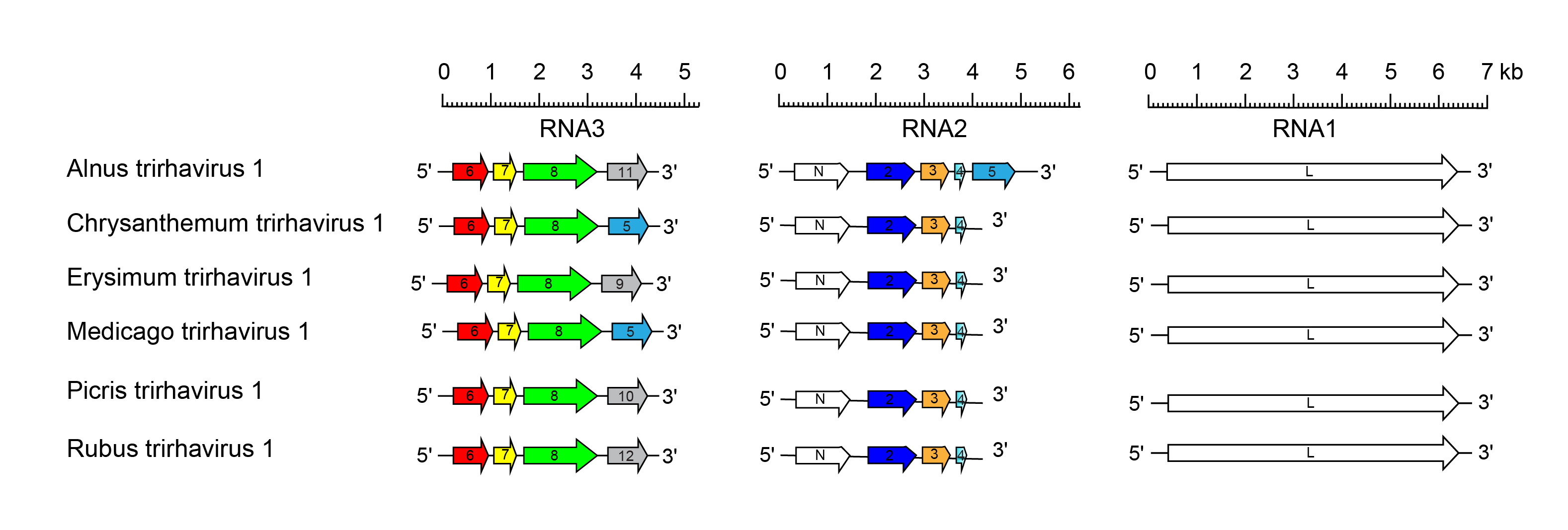 |
| Figure 1 Trirhavirus. Schematic representation of a selection of trirhavirus genomes (RNA1, RNA2 and RNA3) shown in reverse (positive-sense) polarity. N and L represent ORFs encoding the known structural proteins. Other ORFs encode putative proteins of unknown function. ORFs that appear to be homologous are shown in the same color, while those that are not homologous are shown in grey. |
Biology
Viruses in the genus were identified from an in-silico analysis of plant transcriptome datasets.
Species demarcation criteria
Viruses assigned to different species within the genus Trirhavirus have several of the following characteristics: A) nucleotide sequence identity lower than 80% for the L ORF; B) nucleotide sequence identity lower than 80% in RNA2; C) nucleotide sequence identity lower than 80% in RNA 3; and D) occupy different ecological niches as evidenced by differences in hosts
Related, unclassified viruses
| Virus name | Accession number | Virus abbreviation |
| Capsicum trirhavirus 1 | RNA1: PX121450; RNA2: PX121451; RNA3: PX121452 | CapTRV1 |
| Chenopodium trirhavirus 1 | RNA1: PQ653982; RNA2: PQ653983; RNA3: PQ653984 | CheTRV1 |
| Humulus trirhavirus 1 | RNA1: PP824665; RNA2: PP824666; RNA3: PP824667 | HumTRV1 |
| Urtica trirhavirus 1 | RNA1: PQ787168; RNA2: PQ787169*;RNA3: PQ787170 | UrtTRV1 |
Virus names and virus abbreviations are not official ICTV designations.
* Coding region sequence incomplete