
Genus: Betacytorhabdovirus

Subfamily: Betarhabdovirinae
Genus: Betacytorhabdovirus
Distinguishing features
Historically, the genera Nucleorhabdovirus and Cytorhabdovirus were established based on the sites of virus replication and morphogenesis, with cytorhabdoviruses replicating and maturing in the cytoplasm of infected cells. Recently, a reclassification became necessary as phylogenetic analyses of new plant rhabdovirus genomes consistently showed that cytorhabdoviruses did not form a monophyletic clade upon analysis of complete L protein sequence alignments (Rubino et al., 2025).
Based on well-supported Maximum Likelihood or Maximum Clade Credibility trees inferred from complete L protein sequences, viruses classified in the genus Betacytorhabdovirus form a monophyletic cluster clearly distinguished from alpha- and gammacytorhabdoviruses, as well as from other plant rhabdoviruses.
Virion
Morphology
Enveloped virions are bacilliform, 60–75 nm in diameter and 200–350 nm long (Dietzgen, 2002, Jackson et al., 2005a).
Physicochemical and physical properties
The buoyant density in sucrose or potassium tartrate is 1.19–1.20 g cm−3 (Dietzgen, 2002). The lipid envelope is derived from the cytoplasmic membranes of plant or insect host cells (Jackson et al., 2005a).
Nucleic acid
The negative-sense, single-stranded RNA genome of 9.9–16.7 kb is unsegmented. Four to ten mRNAs, one for each of the encoded proteins, have been identified in infected plants.
Proteins
N, P, M, G and L represent the five canonical rhabdovirus structural proteins. The P3 gene, located between the P and M genes, encodes a cell-to-cell movement protein. Northern cereal mosaic virus (NCMV; species Betacytorhabdovirus gramineae) and barley yellow striate mosaic virus (BYSMV; species Betacytorhabdovirus hordei) encode small proteins that have the structural characteristics of class 1a viroporins, similar to those detected commonly in mammalian rhabdoviruses. The functions of other accessory proteins are mostly unknown, but it has been recently suggested that P6 of BYSMV acts as a virus effector to downregulate JA signaling and induce plant attractiveness to insects (Gao et al., 2022).
Lipids
The lipoprotein envelope is derived from the host plant or insect vector (Jackson et al., 2005a). Lipid composition is unknown.
Genome organisation and replication
The typical betacytorhabdovirus genome organisation is similar to that of LNYV virus. Preceded by a non-coding leader sequence, the gene order is 3′-N-P-P3-M-G-L-5′ (Figure 1 Betacytorhabdovirus). The N gene encodes the nucleoprotein (or nucleocapsid protein), and the P, M, G and L genes encode the phosphoprotein (polymerase cofactor), matrix protein, glycoprotein and RNA polymerase, respectively. The P3 gene encodes a cell-to-cell movement protein. The intergenic regions contain highly conserved consensus sequences. The 5′-non-coding trailer sequence has extensive complementarity to the 3′-leader. Several betacytorhabdoviruses contains additional ORFs. The NCMV genome has a gene order similar to that of LNYV, except for the presence of three additional small genes of unknown function between the P and M genes, and an additional gene between the G and L genes that encodes a class 1a viroporin-like protein. The genome of BYSMV (12.7 kb) is similar to that of NCMV, except that one of the additional small ORF (P5) is located in an alternative frame within the P4 gene and is expressed by a leaky scanning mechanism. The genome organisation of betacytorhabdoviruses is quite diverse. Some members show a shorter G gene, while many of them have additional ORFs in distinct genomic positions. Four viruses lack the G gene altogether, and one also lacks the M gene (Bejerman et al., 2023).
Betacytorhabdoviruses replicate in the cytoplasm of infected cells in association with masses of thread-like structures (viroplasms) (Jackson et al., 2005a). Virions bud in association with the endoplasmic reticulum (ER) and accumulate in ER-derived vesicles (Chambers et al., 1965, Wolanski & Chambers 1971 ). A nuclear phase has been suggested but not proven in the replication of some betacytorhabdoviruses (Wolanski & Chambers 1971). Evidence of the nuclear involvement in the replication of others is lacking (e.g., BYSMV). Endogenous transcriptase activity is readily detectable in betacytorhabdovirus preparations (Francki & Randles, 1972).
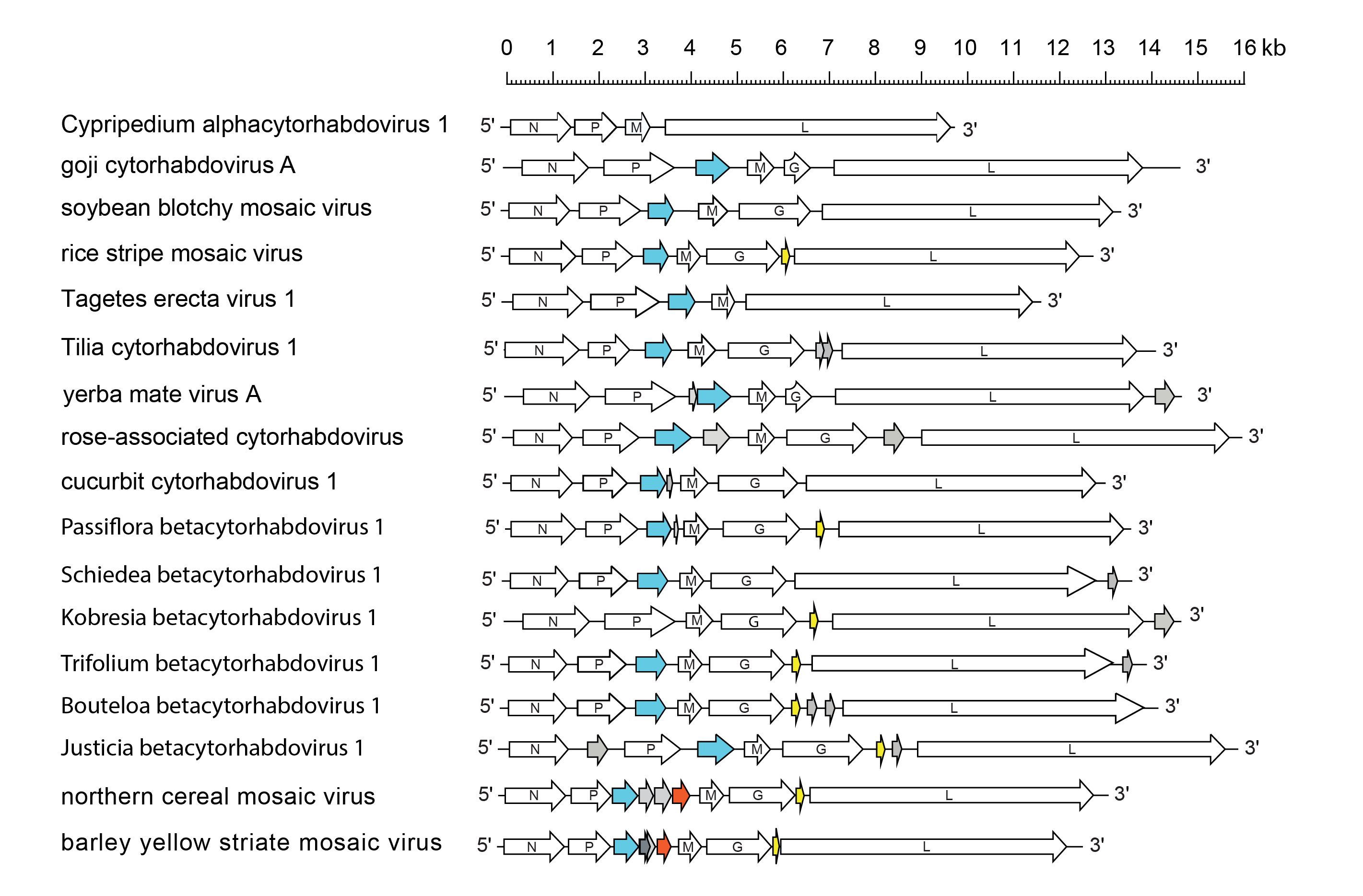 |
| Figure 1 Betacytorhabdovirus. Schematic representation of a selection of betacytorhabdovirus genomes shown in reverse (positive-sense) polarity. N, P, M, G and L represent ORFs encoding the structural proteins. ORFs encoding viral cell-to-cell movement proteins (blue) and predicted class 1a viroporin-like proteins (yellow) are shown. Additional ORFs that appear to be homologous are shown in the same color, while ORFs with no obvious homologues are also shown (grey). In addition to those virus genomes shown: Hepatica betacytorhabdovirus 1, Ixeris denticulata associated rhabdovirus, Rudbeckia virus 1 and Vicia betacytorhabdovirus 1 are similar to Tagetes erecta virus 1; Dryobalanops betacytorhabdovirus 1, Gleditsia betacytorhabdovirus 1, Glycyrrhiza betacytorhabdovirus 1, Morus betacytorhabdovirus 1, Phellodendron betacytorhabdovirus 1, Pueraria betacytorhabdovirus 1, Sophora betacytorhabdovirus 1, Zanthoxylum betacytorhabdovirus 1, Zanthoxylum betacytorhabdovirus 2 and Zahnthoxylum betacytorhabdovirus 3 are similar to goji cytorhabdovirus A; Anthurium Amnicola virus 1, Panicum betacytorhabdovirus 1 and paper mulberry mosaic associated virus are similar to soybean blotchy mosaic virus; Artemisia betacytorhabdovirus 1, Begonia betacytorhabdovirus 1, Betula betacytorhabdovirus 1, Betula betacytorhabdovirus 2, chrysanthemum betacytorhabdovirus 1, Colocasia bobone disease associated virus, Corylus betacytorhabdovirus 1, Cucurbita betacytorhabdovirus 1, Dioscorea rotundata virus 1, Durio betacytorhabdovirus 1, Howea betacytorhabdovirus 1, Ipomoea betacytorhabdovirus 1, Leucadendron betacytorhabdovirus 1, maize associated cytirhabdovirus, mango betacytorhabdovirus 1, Nitraria betacytorhabdovirus 1, pear rhabdovirus 1, peat soil associated betacytorhabdovirus 1, Pentaphragma betacytorhabdovirus 1, Populus betacytorhabdovirus 1 and rose virus R are similar to rice stripe mosaic virus; Aristolochia associated cytorhabdovirus, Bemisia tabaci associated virus 1, papaya virus E, Sesamum betacytorhabdovirus 1 and yerba mate chlorosis associated virus are similar to cucurbit cytorhabdovirus 1; peat soil associated betacytorhabdovirus 2 is similar to Bouteloa betacytorhabdovirus 1. |
Biology
A wide variety of monocot and dicot plants are susceptible to betacytorhabdoviruses, although each virus usually has a restricted host range. Betacytorhabdoviruses are transmitted by planthoppers (NCMV, BYSMV), leafhoppers (rice stripe mosaic virus (RSMV; species Betacytorhabdovirus oryzae) or whiteflies (papaya virus E [PpVE; species Betacytorhabdovirus caricae]). Some viruses are transmitted during vegetative propagation, and some can also be transmitted mechanically from infected sap. Seed transmission has not been reported, but was suggested to be involved in the transmission of Rudbeckia virus 1 (RudV1; species Betacytorhabdovirus rudbeckiae) (Lee et al., 2022). In all carefully examined cases, viruses replicate in cells of the insect vector as well as in the plant host (Jackson et al., 2005a, Redinbaugh & Hogenhout, 2005).
Species demarcation criteria
Viruses assigned to different species within the genus Betacytorhabdovirus have several of the following characteristics: A) nucleotide sequence identity less than 75% for the coding-complete genome sequence; B) amino acid sequence identity less than 86% in proteins encoded by all the cognate open reading frames; and C) they occupy different ecological niches as evidenced by differences in hosts and/or arthropod vectors.
Related, unclassified viruses
| Virus name | Accession number
| Virus abbreviation
|
| Achillea betacytorhabdovirus 1 | PX121435 | AchBCRV1 |
| alfalfa cytorhabdovirus 1 | OK514706* | AlfCRV1 |
| alfalfa cytorhabdovirus 2 | OK514707* | AlfCRV2 |
| cranesbill betacytorhabdovirus 1 | PX121453 | CraBCRV1 |
| Rubus betacytorhabdovirus 1 | PX121465 | RubBCRV1 |
| Stachys betacytorhabdovirus 1 | PX550110 | StaBCRV1 |
Stachys betacytorhabdovirus 2
| PX550111 | StaBCRV2 |
Virus names and virus abbreviations are not official ICTV designations.
* Coding region sequence incomplete