
Family: Phenuiviridae
Genus: Wenrivirus
Distinguishing features
Two viruses are assigned to the genus Wenrivirus. Wenriviruses have been identified in crustaceans such as prawns and shrimps, and viral infection has been associated with their increased mortality. The wenrivirus genome has four genes, encoding a large protein (L), two external glycoproteins (Gn and Gc), a nucleocapsid protein (N) and a non-structural protein (NSs). Based on well-supported Maximum Likelihood or Maximum Clade Credibility trees inferred from complete L protein sequences, viruses classified in the genus Wenrivirus form a monophyletic cluster clearly distinguished from other phenuivirids (Li et al., 2015, Cowley 2021).
Virion
Morphology
Virions are spherical or pleomorphic, 85–100 nm in diameter, and have surface glycoprotein projections which are embedded in a lipid bilayer envelope (Cowley 2016).
Nucleic acid
The wenrivirus genome encompasses four segments of negative-sense RNA: L (6.3 kb), M (3.0 kb), S (1.2–1.6 kb) and S2 (1.2–1.4 kb). The terminal nucleotides of each segment occur in a canonical, conserved sequence (in coding sense) 5′-ACACAAAGAC…CUCUUUGUGU-3′ and may form panhandle structures typical of other members of the class Bunyaviricetes (Table 2 Phenuiviridae). All four genomic RNAs contain untranslated regions flanking a single ORF which, based on comparisons with other negative-sense RNA viruses, is predicted to be contained in the virus complementary strand. In silico analysis of wenrivirus putative ORF sequences suggests that the wenrivirus genome encodes four structural proteins: an RNA-directed RNA polymerase (RdRP) with a predicted molecular mass of 232.9–233.0 kDa, a glycoprotein precursor of 99.3–99.8 kDa (comprising Gn and Gc) and N of 26.6–27.4 kDa, these proteins sharing sequence homology and/or structural characteristics with the cognate proteins of other phenuivirids. The S2 segment encodes a protein of 45.6–46.5 kDa of unknown function (Li et al., 2015, Cowley 2021).
Genome organization and replication
The wenrivirus genome consists of four negative-sense RNAs (Figure 1 Wenrivirus). The wenrivirus genome arrangement is similar to that of horwuviruses (Figure 2 Phenuivridae). The L, M, S, and S2 segments putatively encode L, a glycoprotein precursor comprising Gn and Gc, N, and NSs2, respectively. The Gn and Gc glycoproteins were earlier referred to as G1 and G2 based on apparent size following gel electrophoresis. Details of virus replication are unknown (Li et al., 2015, Cowley 2021).
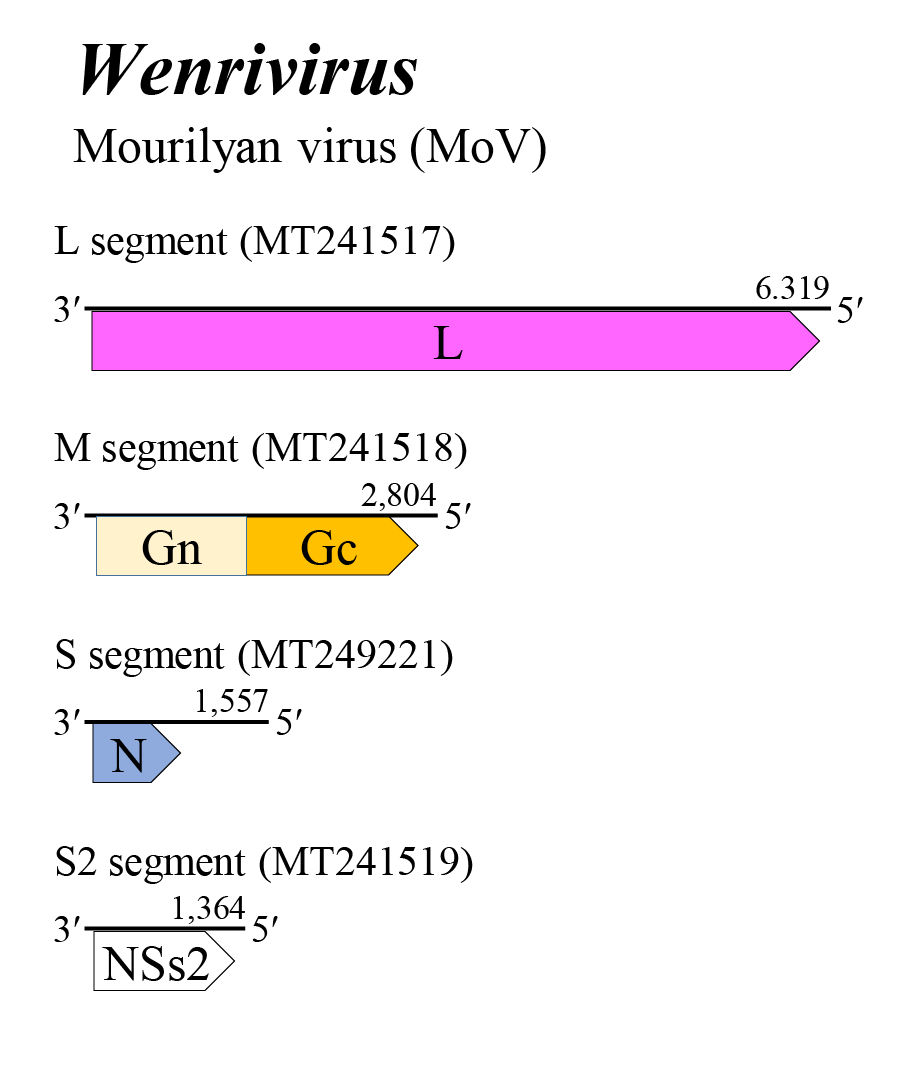 |
| Figure 1 Wenrivirus. Genome organization of a wenrivirus. Coloured boxes depict ORFs that encode N, nucleocapsid protein; Gn and Gc, external glycoproteins; and L, large protein. A white box depicts an ORF that encodes NSs2, non-structural protein. |
Biology
Wenriviruses occurs commonly in black tiger prawns [Penaeus monodon (Fabricius, 1798)], Chinese white shrimp [P. chinensis (Osbeck, 1765)], and kuruma shrimps [P. japonicus (Bate, 1888)] farmed in Australia and China. The viral infection increases the mortality of the prawns and shrimps (Cowley 2020).
Species demarcation criteria
Less than 95% identity in the amino acid sequence of the L protein.
Related, unclassified viruses
| Virus name | Accession number | Virus abbreviation |
| Austropotamobius brown spot virus; bunya-like brown spot virus | L: MK881590; M: MK881591; S: MK881592 | AuBSV |
| Wēnlǐng crustacean virus 7 | Seg1: KX884859; Seg2: KX884860 | WeCV7 |
Virus names and virus abbreviations are not official ICTV designations.Virus names and virus abbreviations are not official ICTV designations.