
Family: Phenuiviridae
Genus: Mobuvirus
Distinguishing features
Fourteen viruses are assigned to the genus Mobuvirus. Mobuviruses have been identified in fleas, moths and mosquitoes. The mobuvirus genome has four genes, encoding a large protein (L), a glycoprotein precursor (GP), a nucleocapsid protein (N) and a non-structural protein (NSs). Based on well-supported Maximum Likelihood or Maximum Clade Credibility trees inferred from complete L protein sequences, viruses classified in the genus Mobuvirus form a monophyletic cluster clearly distinguished from other phenuivirids (Makhsous et al., 2017, Harvey et al., 2019).
Virion
Morphology
Virion morphology is unknown.
Nucleic acid
The mobuvirus genome encompasses three single-stranded segments of negative-sense RNA. Analysis of the terminal sequences has yet to be completed. The L segment (6.3–7.7 kb) encodes a protein with a predicted molecular mass of 220.4–277.4 kDa that is homologous with the bunyaviral RNA-directed RNA polymerase (RdRP) domain. The M segment (1.9–2.0 kb) encodes a protein of 53.1–116.9 kDa that is considered to be a glycoprotein precursor (GP). Unlike other phenuivirid GPs, the mobuvirus GP is not homologous with the conserved phlebovirus glycoproteins G1 and G2. The S segment (0.9–1.6 kb) encodes a protein of 24.8–52.3 kDa that is homologous with the tenuivirus/phlebovirus N domain (Makhsous et al., 2017, Harvey et al., 2019).
Genome organization and replication
The mobuvirus genome consists of three negative-sense RNAs (Figure 1 Mobuvirus). The mobuvirus genome arrangement is similar to that of beidivirus, citriciviruses, goukoviruses, hudiviruses, hudoviruses, phasiviruses, pidchoviruses, and tanzaviruses (Figure 2 Phenuivridae). The L and M segments putatively encode L and the glycoprotein precursor, respectively. The M segment encodes GP, which lacks the phlebovirus glycoprotein G1 and the phlebovirus G2 fusion domain as well as the C-terminal Ig-like domain. Its potential functional congruence with GPs of other phenuivirals remains to be elucidated. The S segment encodes only N, while the S segment of Mothra virus has two open reading frames on the virus-complementary RNA, and encodes N and a protein of 17.1 kDa of unknown function. Details of virus replication are unknown (Makhsous et al., 2017, Harvey et al., 2019).
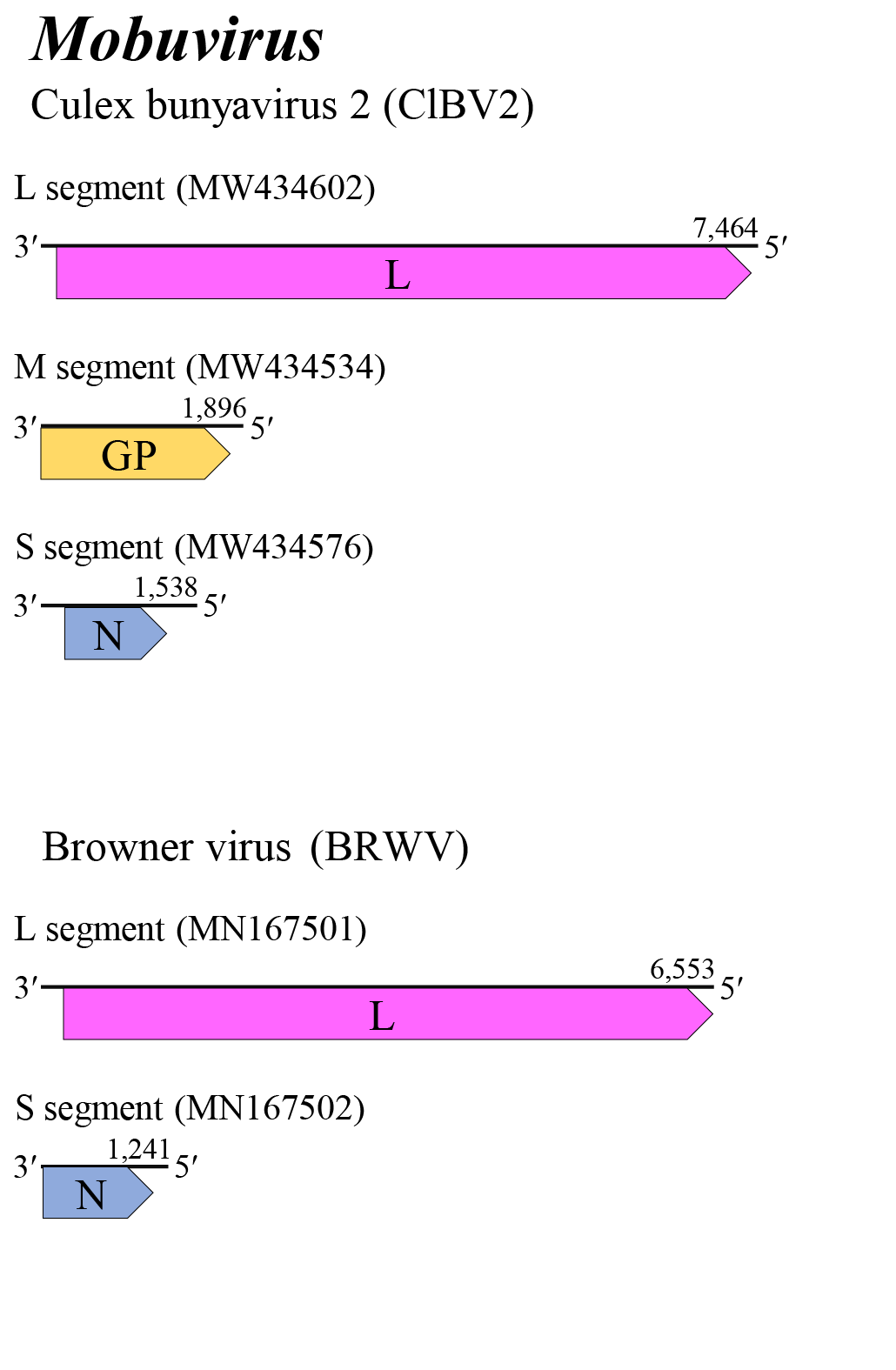 |
| Figure 1 Mobuvirus. Genome organization of mobuviruses. Coloured boxes depict ORFs that encode N, nucleocapsid protein; GP, glycoprotein precursor; and L, large protein. A white box depicts an ORF that encodes NSs, non-structural protein. |
Biology
Mobuvirus RNAs have been detected by high-throughput sequencing of RNAs from pools of several kinds of mosquitoes [Aedes africanus (Theobald, 1901), Anopheles funestus Giles, 1900, Coquillettidia aurites (Theobald, 1901), Culex bitaeniorhynchus Giles, 1901, C. pseudovishnui Colless. 1957, Mansonia titillans (Walker, 1848), C. quinquefasciatus Say, 1823, C. tarsalis Coquillett, 1896, and C. tritaeniorhynchus Giles, 1901] sampled in Cameroon, China, Colombia, South Korea, USA, and Zambia (Orba et al., 2023; Donfack et al., 2024; Faizah et al., 2020) (Faizah et al., 2020, Mbigha Donfack et al., 2024). Mobuvirus RNAs have been also detected in fleas [Stephanocircus pectinipes (Rothschild, 1915) and S. harrisoni (Traub & Dunnet, 1973)] in Australia, tea tussock moths [Euproctis pseudoconspersa (Strand, 1923)] in China, coding moths [Cydia pomonella (Linnaeus, 1758)] in USA, maculated rice katydids [Conocephalus maculatus (Le Guillou, 1841)] in China and in unidentified green lacewings (Li et al., 2015, Makhsous et al., 2017, Harvey et al., 2019, Caldas-Garcia et al., 2023).
Species demarcation criteria
The criteria demarcating species in the genus are:
• Less than 95% identity in the amino acid sequence of the L protein.
Related, unclassified viruses
| Virus name | Accession number | Virus abbreviation |
| Aedes albopictus bunya-like virus | L: LC775041; S: LC775042 | AABLV |
| Blatta orientalis phasmavirus 1 | L: BK067003; S: BK067004 | BOPV1 |
| Blatta orientalis phasmavirus 2 | L: BK067007; S: BK067008 | BOPV2 |
| Blatta orientalis phasmavirus 3 | L: BK067011; S: BK067012 | BOPV3 |
| blattodean phenui-related virus OKIAV261 | L: MT153515; S: MT153529 | BPRV261 |
| blattodean phenui-related virus OKIAV268 | L: MT153544*; S: MT153426 | BPRV268 |
| Chicharrita del maiz bunyan-like virus | L: BK068254; S: BK068255 | ChMBV |
| coleopteran phenui-related virus OKIAV264 | L: MT153464*; S: MT153352 | CPRV264 |
| Degsystermes virus | L: MW052074; S: MW052075 | DegSV |
| Etutanne virus 1 | L: LC642718* | ETTV1 |
| Etutanne virus 2 | L: LC642716* | ETTV2 |
| Etutanne virus 3 | L: LC642717* | ETTV3 |
| Furrundu phlebovirus | L: MN186294*; M: MN186295*; S: MN186296* | FUPV |
| Gonipterus platensis bunyan-like virus | L: MT435497; S: MT435498 | GPBLV |
| Húběi insect virus 1 | Seg1: KX884735; Seg2: KX884736 | HbIV1 |
| Húběi bunya-like virus 2 | Seg1: KX884780; Seg2: KX884781 | HbBLV2 |
| Húběi bunya-like virus 3 | Seg1: KX884778; Seg2: KX884779 | HbBLV3 |
| Hubei bunya-like virus 13 | Seg1: KX884784; Seg2: KX884785 | HbBLV13 |
| Linepithema humile bunyan-like virus 1 | L: MH213237; S: MH213238 | LhuBLV1 |
| Thrips tabaci associated bunyavirales 1 | RNA1: MN764152; RNA2: MN764153 | TTaBV1 |
| Vietnam bat bunyavirus; Bunyavirus sp. strain Bat/VNM/16715 | L: KX886759; S: KX886760 | VnBBV |
| Wǔhàn insect virus 16 | Seg1: KX884854; Seg2: KX884855 | WhIV16 |
| Mobuvirus sp._MEMO115 | L: PP076604; M: PP076608 | MobV115 |
* Sequences do not comprise the complete genome segment.
Virus names and virus abbreviations are not official ICTV designations.