

Family: Phenuiviridae
Genus: Lentinuvirus
Distinguishing features
Three viruses are assigned to the genus Lentinuvirus. Lentinuviruses have been identified in basidiomycete fungi. The lentinuvirus genome comprises two segments of negative-sense RNA (RNA1) and an ambisense RNA (RNA2). Three genes encode two structural proteins, a large protein (L) and a nucleocapsid (N), and one non-structural protein likely functioning as a viral movement protein (MP) that enables cell-to-cell movement in fungus hosts. The apparent lack of a membrane-bound virus particle distinguishes lentinuviruses from other viruses in the family Phenuiviridae. Based on well-supported Maximum Likelihood or Maximum Clade Credibility trees inferred from complete L protein sequences, viruses classified in the genus Lentinuvirus form a monophyletic cluster clearly distinguished from other phenuivirids (Lin et al., 2019).
Virion
Morphology
Virion morphology is unknown.
Nucleic acid
The lentinuvirus genome consists of two single-stranded segments of RNA1 (7.0–7.1 kb) and RNA2 (2.8–3.0 kb). The terminal nucleotides of each segment occur in a canonical, conserved sequence (in coding sense) 5′-ACACAAAGAC…GUCUUUGUGU-3′ and may form the panhandle structures typical of other members of the class Bunyaviricetes. In silico analysis of lentinuvirus putative ORF sequences suggests that the lentinuvirus genome encodes two proteins with predicted molecular masses of 265.5–267.3 kDa and 35.3–36.6 kDa, homologous with the bunyaviral RNA-directed RNA polymerase (RdRP) domain and the tenuivirus/phlebovirus N domain, respectively. The genome may also encode third protein of 47.7–59.6 kDa hat shares sequence homology and/or structural characteristics with the MP of plant viruses (Lin et al., 2019).
Genome organization and replication
The lentinuvirus genome consists of one negative-sense and one ambisense RNAs (Figure 1 Lentinuvirus). The coguvirus genome arrangement is similar to that of coguviruses and entoviruses (Figure 2 Phenuivridae). The lentinuvirus genome encompasses two segments of negative-sense RNA: RNA1, encoding the L protein that is the putative RdRP, and the ambisense RNA2, which is transcribed by the RdRP to form a subgenomic virus-complementary mRNA that encodes N from a viral antigenome RNA2, and also transcribed to form a subgenomic virus-sense mRNA that encodes MP from a viral genome RNA2. The two ORFs on RNA2 are separated by a noncoding intergenic region that potentially forms a long A/U rich stem-loop structure. Since most fungus viruses encode viral suppression proteins that counteract fungus antiviral defence mechanisms based on RNA silencing, one or more of the proteins encoded by lentinuviruses may interfere with RNA silencing. Details of virus replication are unknown (Lin et al., 2019, Kormelink et al., 2021, Rodriguez Coy et al., 2022).
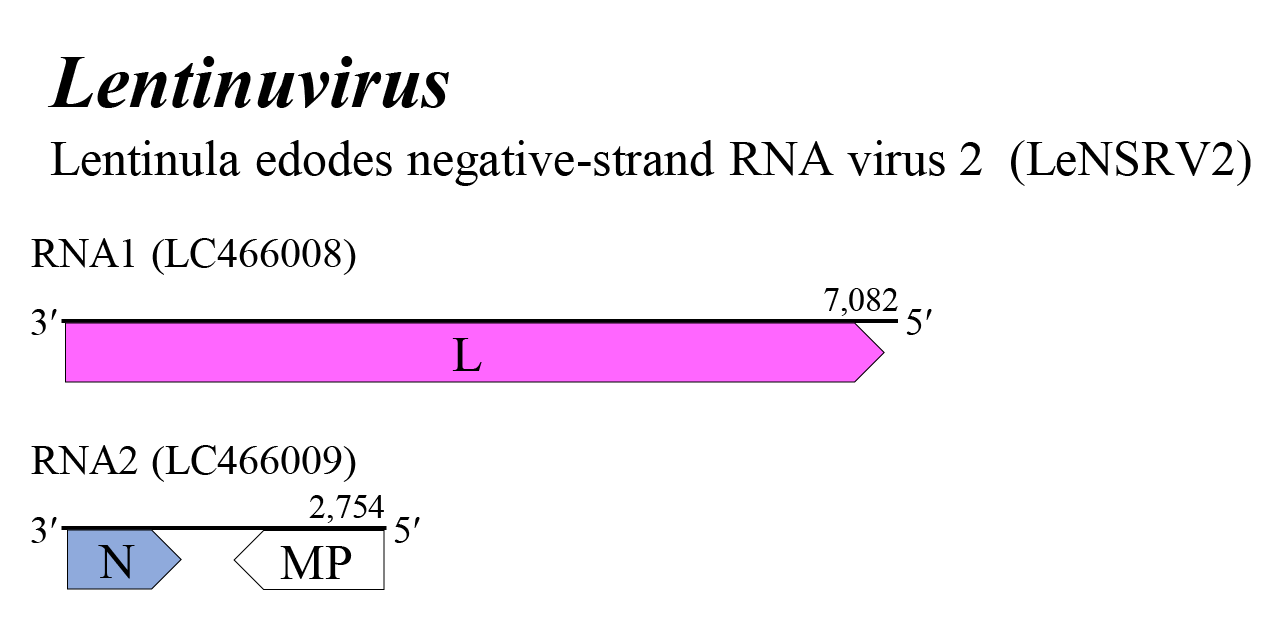 |
| Figure 1 Lentinuvirus. Genome organization of a lentinuvirus. Coloured boxes depict ORFs that encode N, nucleocapsid protein and L, large protein. A white box depicts an ORF that encodes MP, non-structural cell-to-cell movement protein. |
Biology
Lentinuvirus RNAs have been found by high-throughput sequencing of RNA from shiitakes [Lentinula edodes ((Berk.) Pegler, 1976)] collected in China and Japan, and unspecified basidiomycete fungi (Armillaria (Fr.) Staude sp.) collected in Finland. (Lin et al., 2019).
Species demarcation criteria
The criteria demarcating species in the genus are:
• Less than 95% identity in the amino acid sequence of the L protein.
Related, unclassified viruses
| Virus name | Accession number | Virus abbreviation |
| Pleurotus ostreatus lentinuvirus 1 | RNA1: PV524683; RNA2: PV524684 | POLV1 |
| Rhizoctonia cerealis lentinuvirus_RcLeV-0928-1 | L: OQ999719 | RcLeV1 |
| Rhizoctonia cerealis lentinuvirus_RcLeV-0928-3 | L: OQ999681 | RcLeV3 |
Virus names and virus abbreviations are not official ICTV designations.