
Family: Phenuiviridae
Genus: Horwuvirus
Distinguishing features
Three virusesare assigned to the genus Horwuvirus. Horwuvirus RNA has been found by high-throughput sequencing of RNA from fire ants, horseflies, and mosquitoes. The horwuvirus genome has four genes, encoding a large protein (L), a glycoprotein precursor (GP), a nucleocapsid protein (N) and a non-structural protein (NSs), a similar arrangement to that of wenriviruses. Based on well-supported Maximum Likelihood or Maximum Clade Credibility trees inferred from complete L protein sequences, viruses classified in the genus Horwuvirus form a monophyletic cluster clearly distinguished from other phenuivirids. There currently is no cultured horwuvirus isolate (Li et al., 2015, Williams et al., 2020).
Virion
Morphology
Virion morphology is unknown.
Nucleic acid
The horwuvirus genome encompasses four segments of negative-sense RNA, namely L (8.5–9.5 kb), M (2.2–2.8 kb), S (1.9–2.0 kb) and S2 (1.7–2.5 kb). All four genomic RNAs contain untranslated regions flanking a single ORF which, based on comparisons with other negative-sense RNA viruses, is predicted to be contained in the virus-complementary strand. Analysis of the terminal sequences has yet to be completed. In silico analysis of horwuvirus putative ORF sequences suggests that horwuviruses encode three structural proteins: L with a predicted molecular mass of 331.7–363.0 kDa that contains conserved domains characteristic of the bunyaviral RNA-directed RNA polymerase (RdRP) domain, GP of 79.6–93.9 kDa, and N of 34.3–51.6 kDa that is homologous with the tenuivirus/phlebovirus N domain. Unlike other phenuivirid GPs, the horwuvirus GP is not homologous with the conserved phlebovirus glycoprotein G1 and the phlebovirus G2 fusion domain. In addition, the S2 segment, like that of wenriviruses, encodes a non-structural protein (NSs2) of 32.7–41.0 kDa of unknown function (Li et al., 2015, Williams et al., 2020).
Genome organization and replication
The horwuvirus genome consists of four negative-sense RNAs (Figure 1 Horwuvirus). the horwuvirus genome arrangement is similar to that of wenriviruses (Figure 2 Phenuiviridae). The L segment encodes the L protein that includes the RdRP domain. The M segment encode GP, which lacks the phlebovirus glycoprotein G1 and the phlebovirus glycoprotein G2 fusion domain as well as the C-terminal Ig-like domain. Its potential functional congruence with GPs of other phenuivirals remains to be elucidated. In addition, the horwuvirus S2 segment, like that of wenriviruses, encodes a non-structural protein (NSs2) of 33–41 kDa of unknown function. Details of virus replication are unknown (Li et al., 2015, Williams et al., 2020).
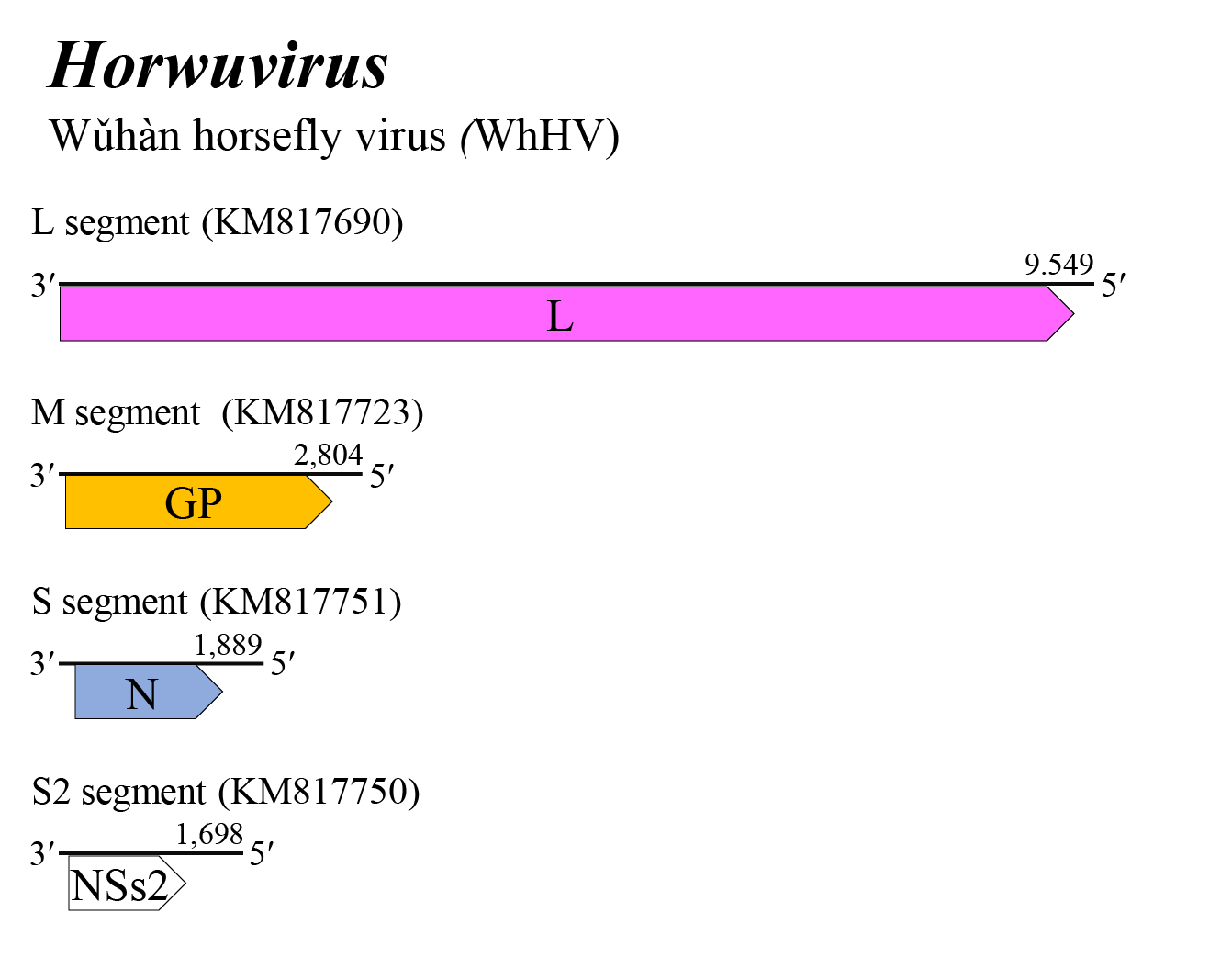 |
| Figure 1 Horwuvirus. Genome organization of a horwuvirus. Coloured boxes depict ORFs that encode N, nucleocapsid protein; GP, glycoprotein precursor; and L, large protein. A white box depicts an ORF that encodes NSs2, non-structural protein. |
Biology
Horwuvirus RNA has been found by high-throughput sequencing of RNA from pools of fire ants [Solenopsis invicta (Buren, 1972)] in USA, horseflies (unidentified Tabanidae) in China, and mosquitoes [Culex annulirostris (Skuse, 1889)] in Australia. (Li et al., 2015, Williams et al., 2020).
Species demarcation criteria
The criteria demarcating species in the genus are:
• Less than 95% identity in the amino acid sequence of the L protein.
Related, unclassified viruses
| Virus name | Accession number | Virus abbreviation |
| Culex tenui-like virus | RNA1: LC772127; RNA2: LC772128; RNA3: LC772129*; RNA4: LC772130 | ClTLV |
| Sanya lschnura senegalensis phenuivirus 1 | L: MZ209917; S: MZ209918 | SISPV1 |
| Cimo phenuivirus V | L: MZ202298* | CPV |
| Mus musculus horwuvirus | L: PX221827; M: PX221828; S: PX221829 | HWV |
* Sequences do not comprise the complete genome segment.
Virus names and virus abbreviations are not official ICTV designations.