
Family: Caulimoviridae
Genus: Ruflodivirus
Distinguishing features
Rudbeckia flower distortion virus (RuFDV), a member of the only species in the genus, is distinguishable from all other members of the family Caulimoviridae by its phylogenetic placement and its unique genome organization. The genome of RuFDV is most similar to that of cauliflower mosaic virus but there is only one small ORF between the movement and capsid protein genes (Lockhart et al., 2017).
Virion
Morphology
Virions of RuFDV are icosahedral, 42–45 nm in diameter.
Nucleic acid
Virions contain a single molecule of non-covalently closed circular dsDNA of 8.2 kbp.
Genome organization and replication
The genome of RuFDV is 8222 bp and contains 7 open reading frames (ORFs) (Figure 1 Ruflodivirus). The only other genera in the family Caulimoviridae whose members have this many ORFs are Caulimovirus, Rosadnavirus and Soymovirus. The genome of RuFDV is most similar to that of cauliflower mosaic virus but there is only one small ORF between the movement and capsid protein genes.
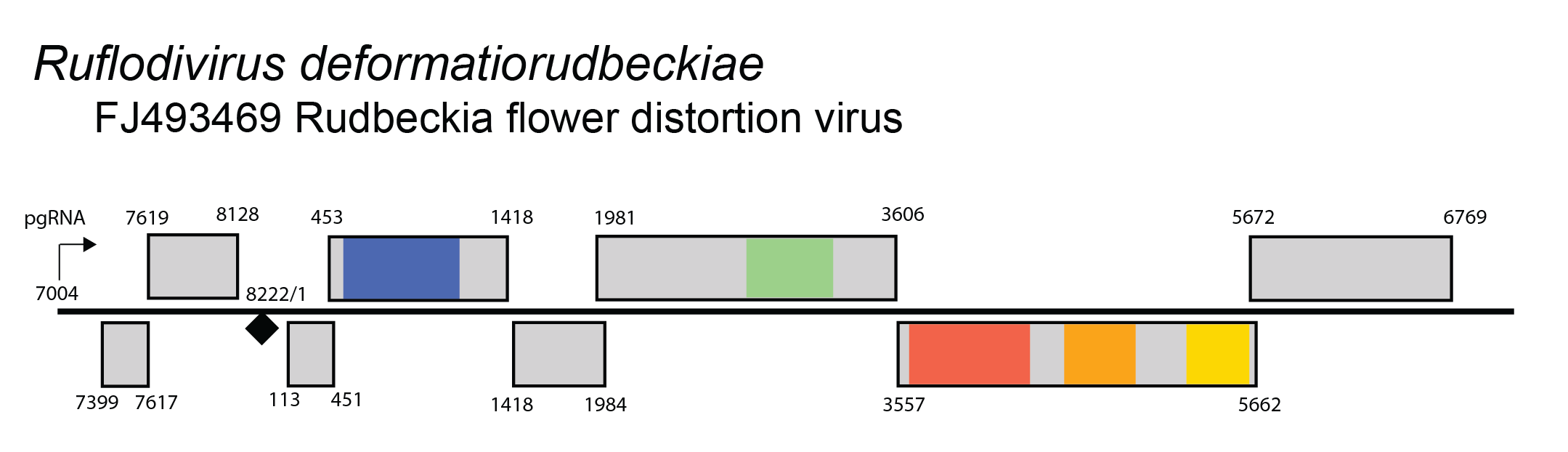 |
| Figure 1 Ruflodivirus Ruflodivirus genome organization. The linearized map begins at the pgRNA transcription start site (black arrow, mapped or predicted about 32 nts downstream of TATA box; see Pooggin et al., 1999 and references therein; M. Pooggin, unpublished sequence analysis). The numbering begins from the first nucleotide of the Met-tRNA primer binding site (black diamond). Light grey boxes mark open reading frames (ORFs). Conserved protein domains as listed in the Pfam database (http://xfam.org) are colored: blue is the viral movement protein (VMP) (PF01107), red is the retropepsin (pepsin-like aspartic protease) (AP) (CD00303), orange is the reverse transcriptase (RT) (CD01647) and yellow is the RNase H1 (RH1) (CD06222). The conserved C-terminus of the coat protein (CP) is marked green. |
Biology
RuFDV has been reported only in Rudbeckia hirta (Black-eyed Susan). It can be transmitted experimentally by the aphid Myzus persicae.
Species demarcation criteria
RufDV is the sole member of the genus.