
Genus: Phragmivirus

Family: Potyviridae
Genus: Phragmivirus
Distinguishing features
The genus includes two species, including isolates of common reed chlorotic stripe virus (CRCSV) and Spartina mottle virus (SpMV). The genome organization is similar to that of potyviruses and rymoviruses, encoding both the P3N-PIPO and a polyprotein from which 10 mature proteins are produced. Phragmiviruses encode a shorter P1 protein compared to those found in potyviriuses, but comparable to those of rymoviruses.
Virion
Morphology
Virions are flexuous filaments with a modal length of 850 nm.
Nucleic acid
Virions contain a single molecule of linear, positive-sense ssRNA of about 9.4 kb.
Proteins
There is a single coat (capsid) protein of about 35 kDa.
Genome organization and replication
The genome organization (Figure 1 Phragmivirus) is identical to that of most monopartite viruses in the family Potyviridae (Figure 2 Potyviridae).
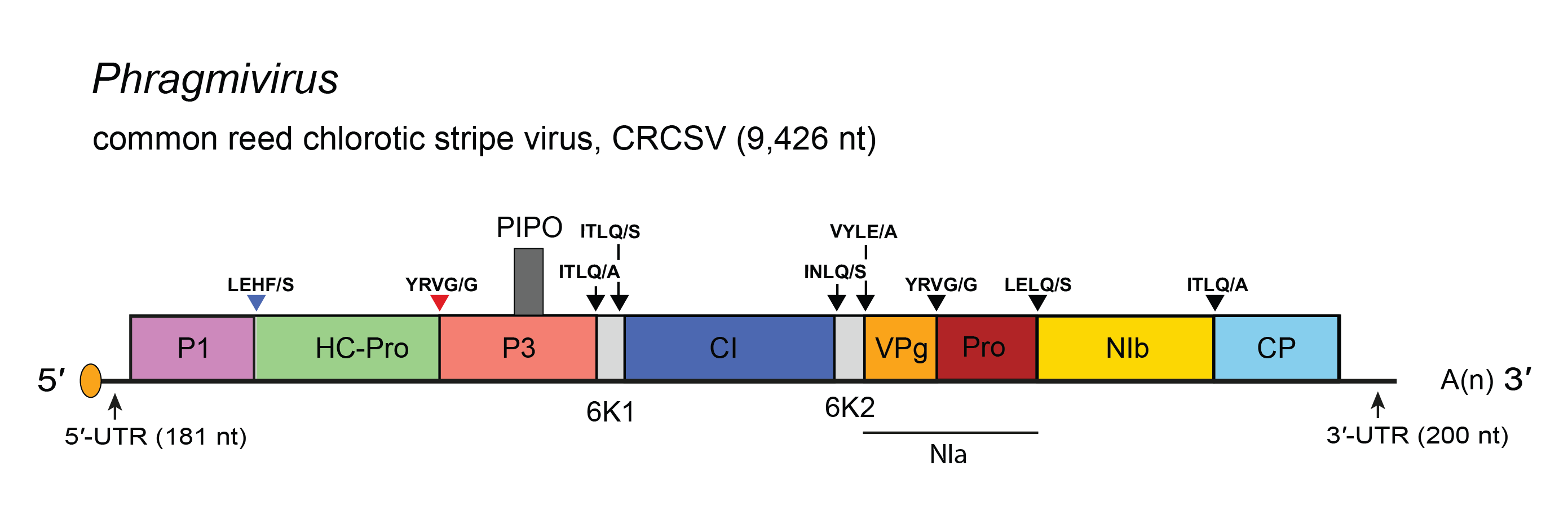 |
| Figure 1 Phragmivirus. Schematic diagram of the common reed chlorotic stripe virus (CRCSV) genome. The polyprotein ORF is indicated by the large open box divided into putative mature proteins. The pretty interesting Potyviridae protein (PIPO) is represented by a small box. The untranslated regions (UTR) are represented by lines on each end of the large ORF. Activities of mature proteins are postulated by analogy with genus Potyvirus. Conventions are as for the potyvirus genome organization map (Figure 2.Potyviridae). Not to scale. |
Biology
Host range
The reported host of CRCSV isolate was the common reed Phragmites australis, while the hosts for SpMV were described in Spartina spp. and Bermuda grass.
Transmission
The vector is not known for either phragmivirus. The absence of the three conserved aphid-transmission motifs in the HC-Pro and in the CP suggests that these viruses might not be transmitted by aphids, though low rate transmission of SpMV isolates to Bermuda grass was reported, hence the transmission properties need further investigation.
Antigenicity
Serological analyses of SpMV isolates showed no reaction with members of the family Potyviridae, including potyviruses, rymoviruses and tritimoviruses. No reaction was observed when SpMV was tested against genus-specific monoclonal antibody for potyviruses (potytest AS-0573/1 DSMZ, Braunschweig, Germany).
Species demarcation criteria
See discussion under family description.