
Family: Inseviridae

Family: Inseviridae
Holly R. Hughes and Stephen R. Sharpe
The citation for this ICTV Report chapter is the summary published as Hughes & Sharpe (2026): ICTV Virus Taxonomy Profile: Inseviridae 2026, J Gen Virol (in press)
Corresponding author: Holly R. Hughes ([email protected])
Edited by: Evelien Adriaenssens
Posted: November 2026
Summary
The family Inseviridae includes dsRNA viruses of invertebrates (Table 1 Inseviridae) and was established in 2024. Inseviruses are non-enveloped icosahedral viruses with a single dsRNA molecule genome. The family includes the genus Insevirus, and 16 species.
Table 1 Inseviridae. Characteristics of members of the family Inseviridae.
| Characteristic | Description |
| Example | Sogatella furcifera totivirus 1 (MG546515), species Insevirus jyuichi |
| Virion | Non-enveloped, icosahedral particles, 30 nm in diameter |
| Genome | One linear segment of bicistronic dsRNA (5.3–6.6 kbp) |
| Replication | Unknown |
| Translation | Presumably involving −1 ribosomal frameshifting |
| Host range | Invertebrates |
| Taxonomy | Realm Riboviria, kingdom Orthornavirae, phylum Duplornaviricota, class Chrymotiviricetes, order Ghabrivirales, suborder Betatotivirineae: 1 genus and 16 species |
Virion
Morphology
Insevirids have been shown to have an icosahedral, non-enveloped virion about 30nm in diameter (Koyama et al., 2015).
Nucleic acid
Insevirids have a single segment of dsRNA (5.3–6.6 kb). The genome has two open reading frames; expression of the downstream open reading frame may be the result of a −1 ribosomal frame shift (Koyama et al., 2015, Zhang et al., 2018).
Proteins
The upstream open reading frame produces the capsid protein (about 122 kDa), and the downstream ORF after a −1 ribosomal frame shift produces the RNA-directed RNA polymerase (RdRP, about 90 kDa) (Zhang et al., 2018). A hypothetical protein of unknown function has been identified upstream of the capsid protein in some inseviruses (Shi et al., 2019).
Genome organization and replication
Details of the replication of insevirids are unknown. The translation of the genes results in a fusion protein of the capsid and RdRP, via the presence of a pseudoknot upstream of the second ORF that facilitates a −1 ribosomal frame shift (Koyama et al., 2015) (Figure 1 Inseviridae).
 |
| Figure 1 Inseviridae. Genome organisation of Sogatella furcifera totivirus 1, a member of the family Inseviridae. Boxes indicate open reading frames as annotated on GenBank accession MG546515. |
Biology
Insevirids have been identified in a wide range of invertebrates throughout the world. Inseviruses have been detected in all caste and developmental stages and isolated from ants (Camponotus yamaokai Terayama & Satoh, 1990) (Koyama et al., 2015), and identified by high-throughput sequencing of Aedes (Shi et al., 2019), Anopheles (Fauver et al., 2016, Colmant et al., 2017), and Culex (Wang et al., 2021) mosquitoes, in all tissues and development stages of white-backed planthoppers (Sogatella furcifera (Horvath, 1899)) (Zhang et al., 2018), fruit flies (Bactrocera dorsalis (Hendel, 1912)) (Zhang et al., 2020), ticks, dipterans, crabs, spirurian nematodes (Shi et al., 2016), and black soldier flies (Hermetia illucens (Linnaeus, 1758)) (Walt et al., 2024). The presence of insevirids in all developmental stages of multiple host species suggest that they may be vertically transmitted.
Derivation of names
Inseviridae, Insevirus: from insect toti-like virus, referring to the host of viruses in the family and the relationship to totiviruses; the suffix ‑viridae for family taxa or suffix -virus for genus taxa.
Species epithets are derived from Latinized Japanese numbers.
Relationships within the family
Phylogenetic relationships based on the amino acid sequences of the RdRP are shown in Figure 2 Inseviridae.
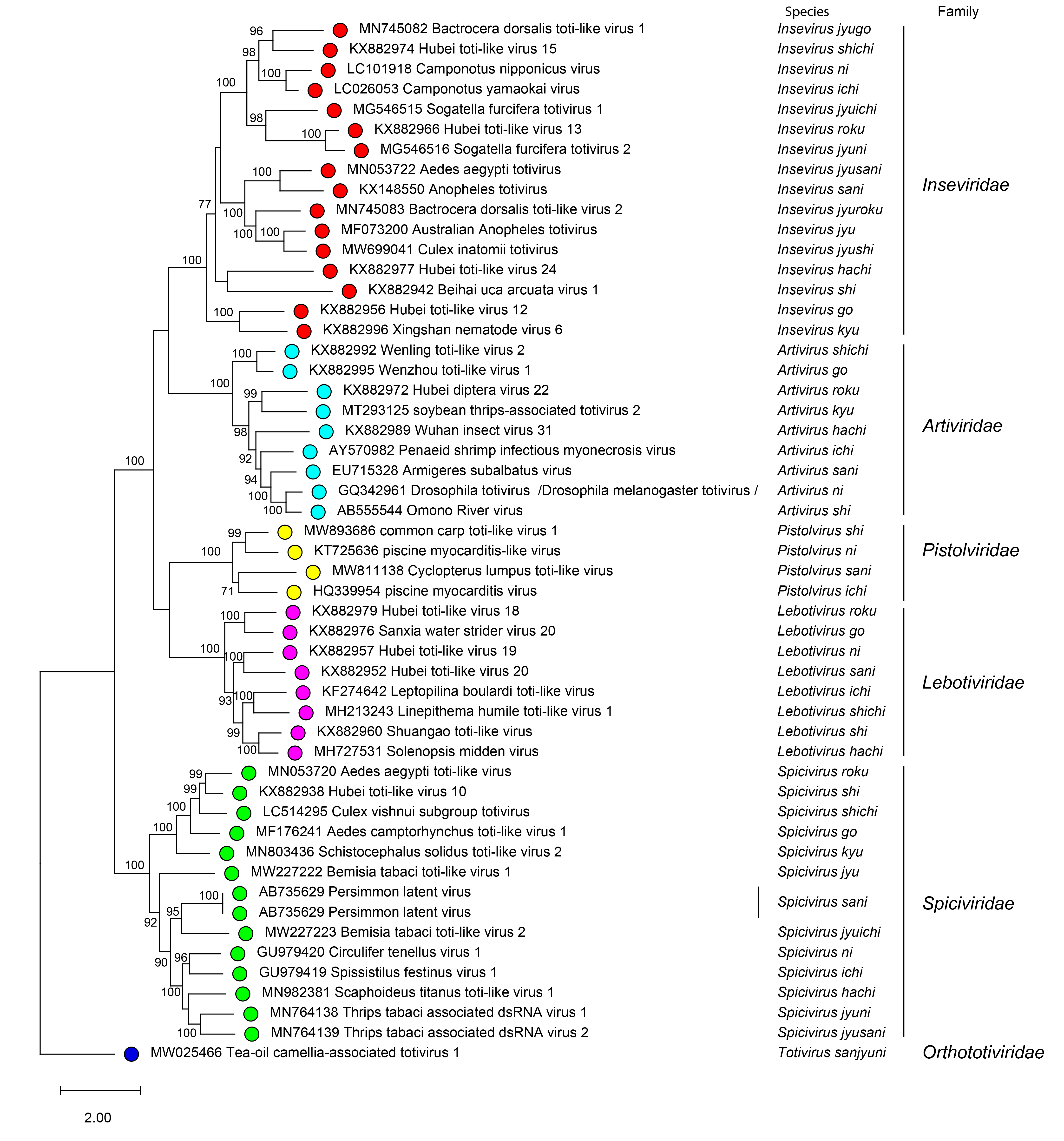 |
| Figure 2 Inseviridae. Phylogenetic inference based on the RdRP of family Inseviridae in relation to selected other families within the order Ghabrivirales. Coding sequences of the RdRP for each virus were downloaded from NCBI virus and aligned with CLUSTAL Omega (EMBL-EBI). Phylogenies were inferred with IQ-Tree (www.hiv.lanl.gov) with 1,000 ultrafast bootstrap replicates using the substitution model VT+F+R5. Bootstrap values are shown where these were >70%. |
Relationships with other taxa
The family Inseviridae is closely related to the family Artiviridae, and other families within the suborder Betatotivirineae (Figure 2 Inseviridae). RdRP amino acid identities between families within the suborder range from 13.7 to 24.1%.
Related, unclassified viruses
| Virus name | Accession number | Virus abbreviation |
| Ambato Boeny inse-like virus | PZ763759 | |
| Amparafaravola inse-like virus | PZ763843 | |
| Batalimo inse-like virus | PZ761653 | |
| Bouar inse-like virus | PZ761700 | |
| Gbozo inse-like virus | PZ762037 | |
| Hermetia illucens inse-like virus 1 | PP968021 | |
| Mampikony inse-like virus | PZ763045 | |
| Mbaiki inse-like virus | PZ762063 | |
| Pissa inse-like virus | PZ762840 | |
| Remire Montjoly inse-like virus | PZ763682 |
Virus names and virus abbreviations are not official ICTV designations.