
Family: Artiviridae

Family: Artiviridae
Holly R. Hughes and Stephen R. Sharpe
The citation for this ICTV Report chapter is the summary published as Hughes & Sharpe (2026): ICTV Virus Taxonomy Profile: Artiviridae 2026, J Gen Virol (in press)
Corresponding author: Holly R. Hughes ([email protected])
Edited by: Evelien Adriaenssens
Posted: November 2026
Summary
The family Artiviridae consists of dsRNA viruses of invertebrates (Table 1 Artiviridae) and was established in 2024. Artivirids are non-enveloped viruses with a genome comprising a single dsRNA molecule. The two open reading frames produce a capsid, RNA-directed RNA polymerase, protein cleavage products, and a capsid-fiber protein. The family includes a single genus, Artivirus, with nine species.
Table 1 Artiviridae. Characteristics of members of the family Artiviridae.
| Characteristic | Description |
| Example | Omono River virus (AB555544), species Artivirus shi |
| Virion | Non-enveloped, icosahedral particles of 40 nm diameter |
| Genome | One linear segment of dsRNA of 6.6–8.3 kbp |
| Replication | Unknown |
| Translation | Possibly involving −1 frameshifting |
| Host range | Invertebrates |
| Taxonomy | Realm Riboviria, kingdom Orthornavirae, phylum Duplornaviricota, class Chrymotiviricetes, order Ghabrivirales, suborder Betatotivirineae: 1 genus and 9 species |
Virion
Morphology
Artivirids have been visualised as icosahedral virions 40nm in diameter without any envelope (Poulos et al., 2006, Isawa et al., 2011). The 120-subunit capsid (T=1) has fiber-like surface protrusions extending 80 angstroms (Tang et al., 2008) (Figure 1 Artiviridae)
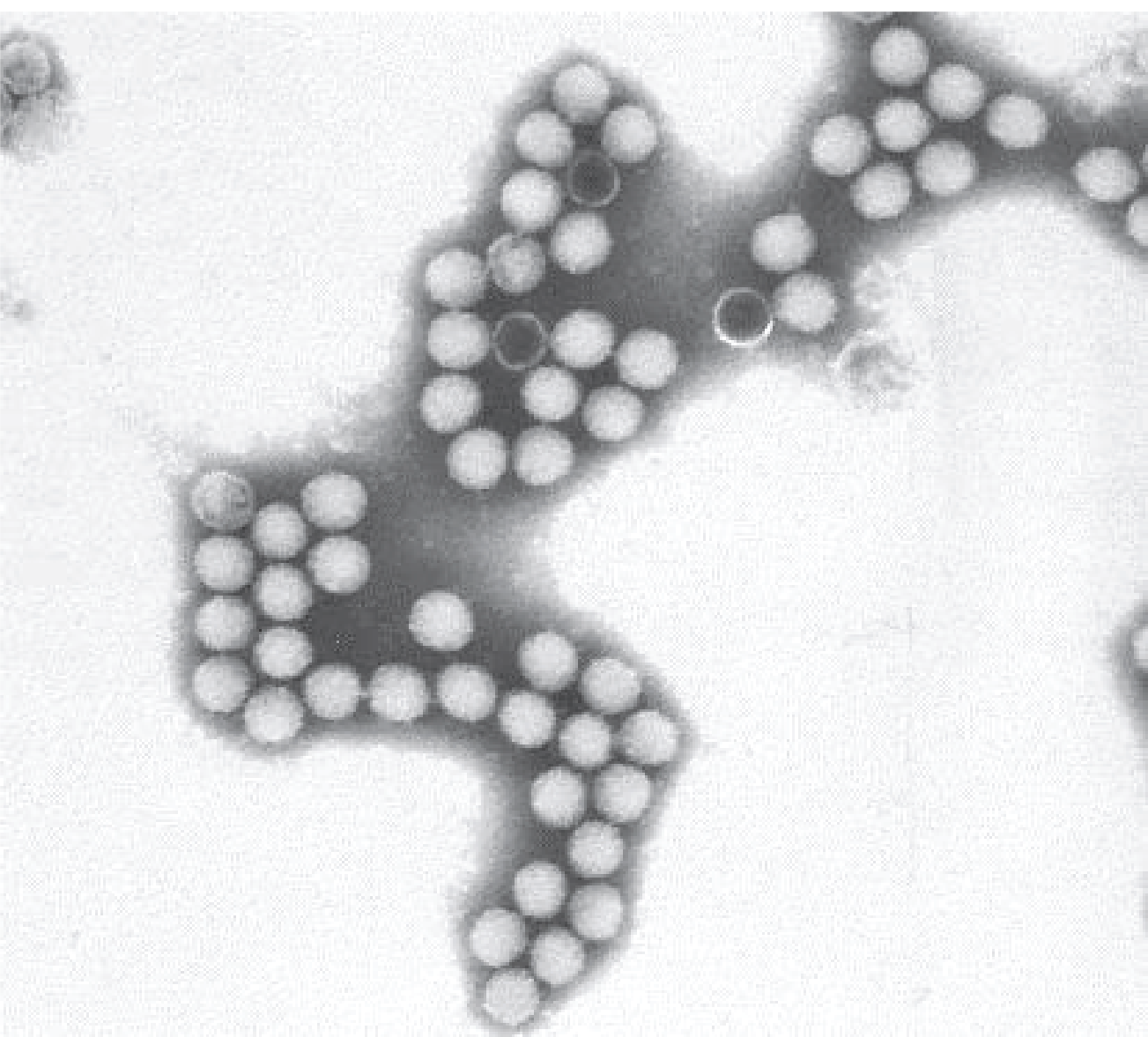 |
| Figure 1 Artiviridae. Transmission electron micrograph of penaeid shrimp infectious myonecrosis virus. Image used under Creative Commons license BY-NC-SA 3.0 from (Tang et al., 2019). |
Nucleic Acid
The genome comprises a single segment of dsRNA of 6.6–8.3 kbp with two open-reading frames. A conserved pseudoknot may produce a precursor protein through a −1 ribosomal frame shift (Zhai et al., 2010).
Proteins
Artiviruses have been demonstrated to produce a capsid protein about 99 kDa, an RNA-directed RNA polymerase (RdRP) of 192 kDa, and three protein cleavage products that have similarity to dsRNA binding proteins (Poulos et al., 2006), or correspond to capsid-fiber complexes involved in cell entry or pathogenesis (Tang et al., 2008).
Genome organization and replication
The complete replication strategy of artivirids has not been elucidated, however several features of replication have been described. The fiber-like protrusion proteins are suggested to bind extracellular receptors and play a role in transmission (Shao et al., 2021). Endocytosis, and acidification are believed to cause dissociation of the protrusion protein and conformational changes that facilitate replication (Shao et al., 2021). The untranslated regions of viral RNA have complementary nucleotides that are predicted to form panhandle-like structure, suggesting a binding site for the RdRP (Zhai et al., 2010). Similar structures have been identified in dsRNA viruses in the order Reovirales. The ORF encoding the RdRP is believed to be expressed as a fusion of the capsid and RdRP proteins produced from a −1 ribosomal frame shift as a result of a slippery heptamer sequence in the overlap between ORF1 and ORF2 (Nibert 2007, Zhai et al., 2010) (Figure 2 Artiviridae). The artivirid genome contains at least one 2A-like motif for ribosomal skipping and cleavage of viral polyprotein precursors (Isawa et al., 2011). This suggests co-translational cleavage of the polyprotein into the capsid, dsRNA binding protein, protrusion protein, and RdRP (Zhai et al., 2010).
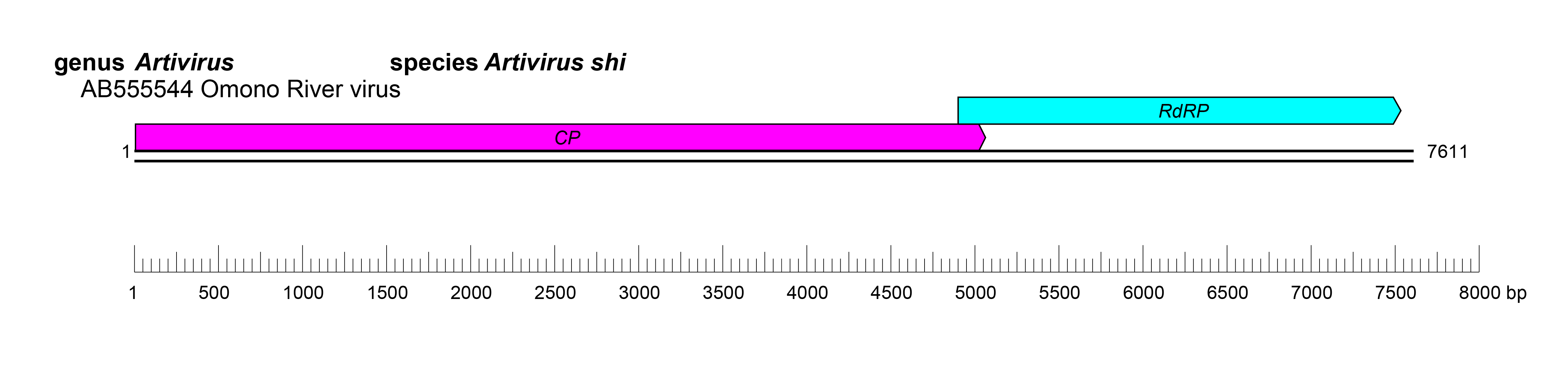 |
| Figure 2 Artiviridae. Genome organisation of Omono River virus, a member of the family Artiviridae. Boxes indicate open reading frames as annotated on GenBank accession AB555544 with the addition of −1 frameshifting (Zhai et al., 2010). |
Biology
Artivirids have been detected in several arthropods including insects and crustaceans. Virus isolates have been obtained from Culex (Cx. pipiens pallens Coquillett, 1898, Cx. Inatomii Kamimura & Wada, 1974) (Isawa et al., 2011) and Armigeres subalbatus (Coquillett, 1898) (Zhai et al., 2010) mosquitoes, as well as penaeid shrimp (Poulos et al., 2006). Skeletal muscle necrosis and necrotic lesions were induced in Penaeus vannamei after injection with infectious myonecrosis virus IMNV, resulting in mortality (1). A severe cytopathic effect was induced in C6/36 (Aedes albopictus (Skuse, 1894)) mosquito cells when infected with two strains of Omono river virus (OMRV-AK4, OMRV-Y61) (2). High-throughput sequencing has further described artiviruses in thrips (Thekke-Veetil et al., 2020), ticks (Tian et al., 2025, Xiang et al., 2025), Drosophila (Wu et al., 2010) and in other diptera, fleas, ants, and crabs (Shi et al., 2016).
Derivation of names
Artiviridae, Artivirus: from arthropod totivirus, referring to the hosts of members in the family and the relationship to totiviruses; the suffix ‑viridae for family taxa or the suffix -virus for genus taxa.
Species epithets are latinized Japanese numbers.
Relationships within the family
Phylogenetic relationships based on the amino acid sequences of the RdRP are shown in Figure 3 Artiviridae.
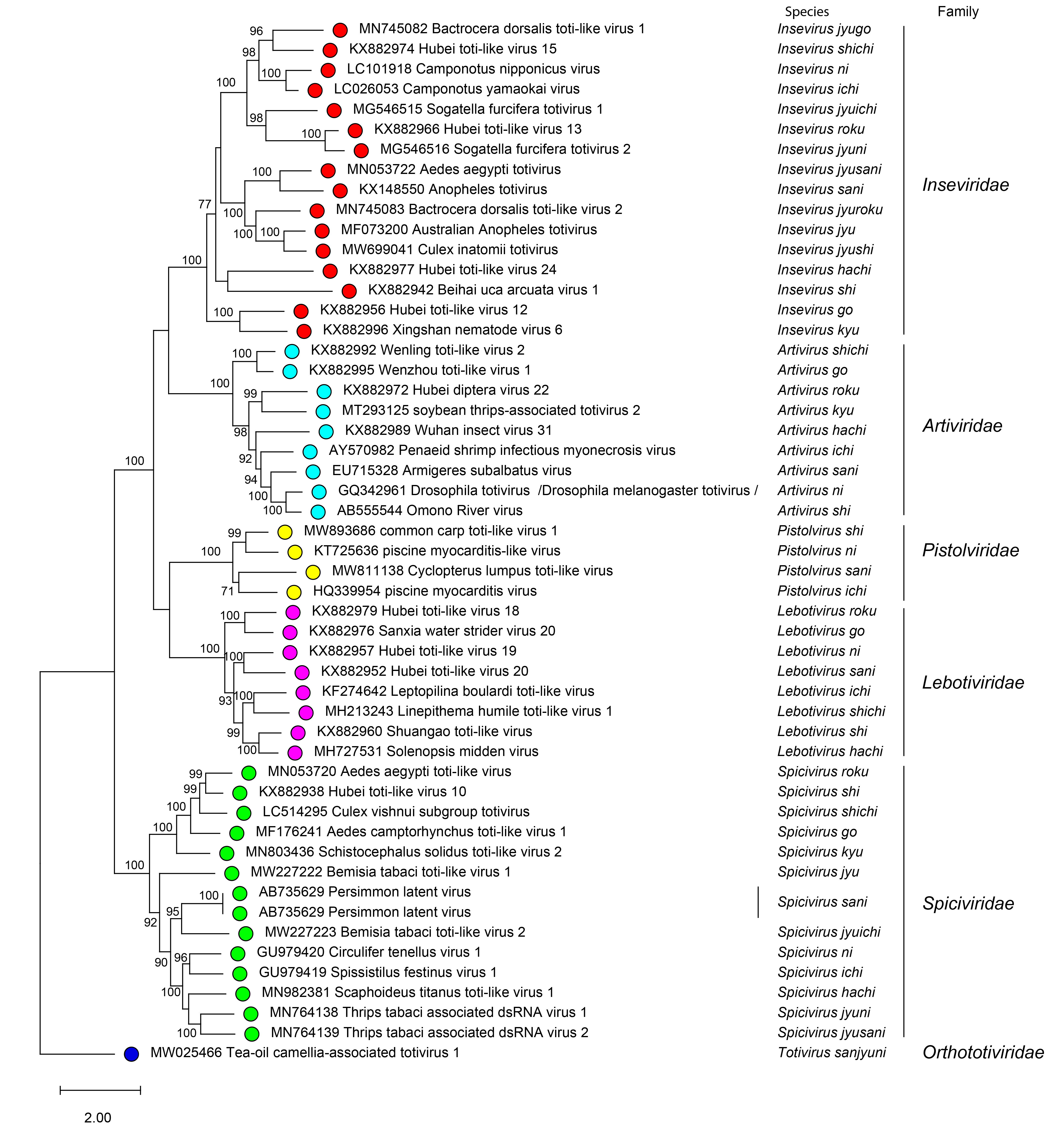 |
| Figure 3 Artiviridae. Phylogenetic inference based on the RdRP of members of the family Artiviridae in relation to selected other families within the order Ghabrivirales. Coding sequences of the RdRP for each virus were downloaded from NCBI virus and aligned with CLUSTAL Omega (EMBL-EBI). Phylogenies were inferred with IQ-Tree (www.hiv.lanl.gov) with 1,000 ultrafast bootstrap replicates using the substitution model VT+F+R5. Numbers at nodes are bootstrap values where these were >70% |
Relationships with other taxa
The family Artiviridae is closely related to the family Inseviridae, and other families within the suborder Betatotivirineae (Figure 3 Artiviridae). RdRP amino acid identities between families within the suborder range from 13.7 to 24.1%.
Related, unclassified viruses
| Virus name | Accession number | Virus abbreviation |
| Yunnan arti-like virus 163 | PQ754364 | |
| Yunnan arti-like virus 166 | PQ754365 | |
| Yunnan arti-like virus 169 | PQ754366 | |
| Yunnan arti-like virus 170 | PQ754367 | |
| Yunnan arti-like virus 171 | PQ754368 | |
| Yunnan arti-like virus 173 | PQ754369 |
Virus names and virus abbreviations are not official ICTV designations.