
Family: Konkoviridae

Family: Konkoviridae
Yutaro Neriya (煉谷裕太朗), Laura Miozzi, Anna Maria Vaira, Yasuhiro Tomitaka (冨髙保弘), and Takahide Sasaya (笹谷孝英)
The citation for this ICTV Report chapter is the summary to be published as Neriya et al., (2026):
ICTV Virus Taxonomy Profile: Konkoviridae 2026, Journal of General Virology, (in press)
Corresponding author: Takahide Sasaya (笹谷孝英) ([email protected])
Edited by: Luisa Rubino & Evelien Adriaenssens
Posted: May 2026
Summary
Konkoviridae is a family of negative-sense RNA viruses, with genomes of 8.7–10.6 kb (Table 1 Konkoviridae). These viruses have filamentous virions in the shape of kinked circles of at least two different contour lengths and are associated with plants. The family includes a single genus with seven species. The konkovirus genome consists of three or four negative-sense, and possibly ambisense, RNA segments with three to six open reading frames that encode a large protein containing an RNA-directed RNA polymerase domain, a nucleoprotein, a putative cell-to-cell movement protein, and additional one to three non-structural proteins of unknown functions.
Table 1 Konkoviridae. Characteristics of members of the family Konkoviridae
| Characteristic | Description |
| Example | tulip streak virus (RNA1: LC571987; RNA2: LC571988; RNA3: LC805881; RNA4: LC805882), species Olpivirus tulipae |
| Virion | Filamentous virions, 7–11 nm in diameter, 300–1600 nm in length |
| Genome | 8.7–10.6 kb in total, comprising 4 segments of negative-sense RNA of 1.1–6.4 kb with pan-handle termini |
| Replication | Unknown |
| Translation | Unknown |
| Host range | Dicotyledonous plant species including lettuce and tulip |
| Taxonomy | Realm Riboviria, kingdom Orthornavirae, phylum Negarnaviricota, class Bunyaviricetes, order Hareavirales: 1 genus and 7 species |
Virion
Morphology
Filamentous particles are spiral-shaped, forming panhandle-like kinked circles, 7–11 nm in diameter, with lengths proportional to those (300–1600 nm) of the segmented genomic RNAs (Figure 1 Konkoviridae) (Neriya et al., 2021).
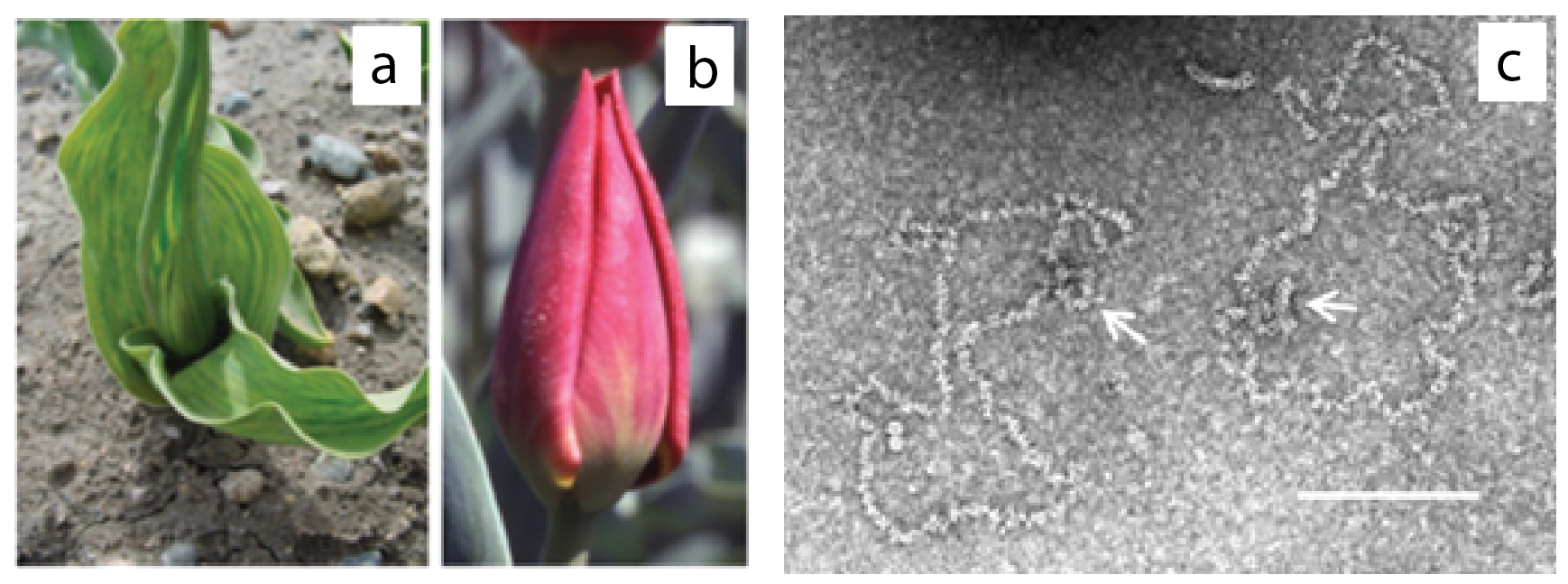 |
| Figure 1 Konkoviridae. Tulips infected with tulip streak virus (a, b) and negative-contrast electron micrograph (uranyl acetate) of tulip streak virus (c). The bar represents 100 nm. Panhandle forms of the large particles are indicated by arrows (Courtesy of T. Morikawa). |
Nucleic acid
The viral genome comprises three or four single-stranded molecules of negative-sense or ambisense RNA, which total 8.7–10.6 kb (RNA1: 6.3–6.4 kb; RNA2: 1.0–1.3 kb; RNA3: 1.2–1.6 kb; and RNA4: about 1.3 kb). The terminal nucleotides of each genome RNA segment are base-paired, possibly forming non-covalently closed RNP complexes (Neriya et al., 2021, Neriya and Nishigawa 2024, Schravesande et al., 2024, Marra et al., 2026).
Proteins
Konkoviruses encode two structural proteins, a large protein (L) with predicted molecular masses of 238–240 kDa encoded by the RNA1, and a nucleocapsid protein (NP) of 26–33 kDa encoded by the RNA2. L and NP include the bunyaviral RNA-directed RNA polymerase (RdRP) domain and the tenuivirus/phlebovirus nucleoprotein domain, respectively. Additionally, konkoviruses encode a putative movement protein (pMP) of 38–41 kDa encoded by RNA3 that shares sequence homology and/or structural characteristics with the cell-to-cell movement protein (MP) of plant viruses. Certain viruses additionally encode (on RNA2 and RNA4) one to three non-structural proteins of unknown function (Neriya et al., 2021, Neriya and Nishigawa 2024, Schravesande et al., 2024, Marra et al., 2026).
Genome organization and replication
Konkoviruses have genomes with three or four segments that encode L, NP, and pMP, and an additional one to three proteins of unknown function. RNA1 is negative-sense and encodes L on the virus-complimentary (vc)RNA. RNA2 encodes NP on the vcRNA. In the cases of Lactuca big vein-associated phlebovirus (LBVaPV) and tulip streak virus (TuSV) RNA2 may also encode one or two putative nonstructural proteins of unknown function on the virus-sense RNA. RNA3 encodes a putative movement protein on the vcRNA. RNA4 is encodes a putative nonstructural protein of unknown function on the vcRNA (Figure 2 Konkoviridae) (Neriya et al., 2021, Neriya and Nishigawa 2024, Schravesande et al., 2024). Details of virus replication are unknown.
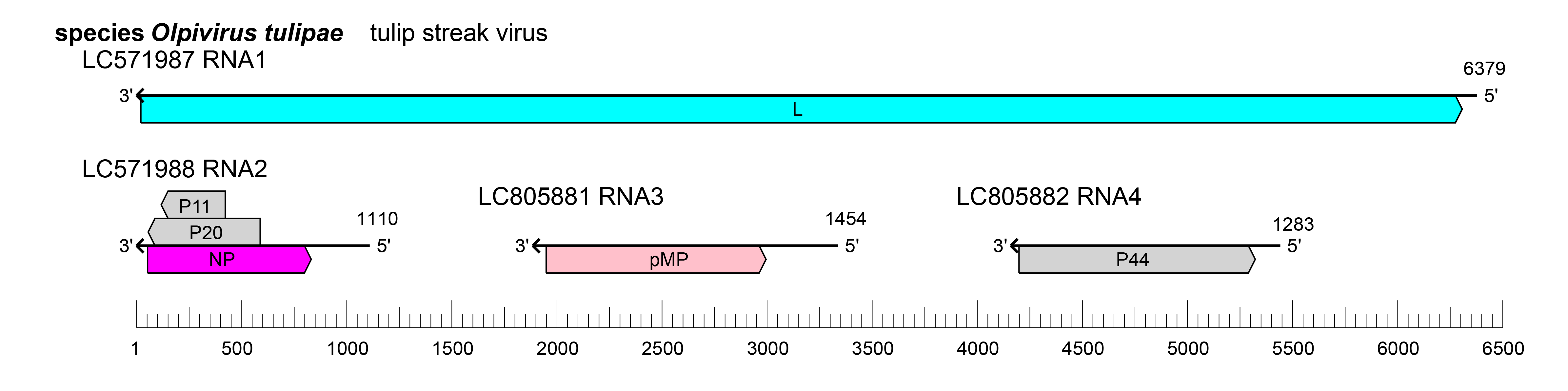 |
| Figure 2 Konkoviridae. Genome organization of tulip streak virus. The virus- (v)RNAs are depicted in 3′→5′ direction. Coloured boxes depict ORFs that encode L, large protein; NP, nucleoprotein; pMP, putative cell-to-cell movement protein. Gray arrows depict ORFs that encode nonstructural proteins of unknown function (P11, P20, and P44). |
Biology
Konkovirids are generally associated with plants where they may cause symptoms. Two konkoviruses detected in plants can be transmitted by the soil-inhabiting fungus, Olpidium virulentus (synonym O. brassicae), belonging to the family Olpidiaceae. TuSV was discovered in tulips (Liliaceae, Tulipa gesneriana L., 1753) with streaking symptoms in Japan (Neriya et al., 2021). TuSV can also be mechanically transmitted using diseased-tulip sap extracts to Nicotiana benthamiana plants (Solanaceae, Nicotiana benthamiana Domin, 1929), inducing local necrotic lesions and systemic mosaic and necrosis, and quinoa (Amaranthaceae, Chenopodium quinoa Willd., 1798), producing local necrotic lesions. LBVaPV was discovered in lettuce (Asteraceae, Lactuca sativa L., 1753) with big-vein symptoms in the Netherlands (Schravesande et al., 2024). Freesia konkovirus 1 (FreKV1), Tripterocalyx-associated konkovirus 1 (TaKV1), Waitzia-associated konkovirus 1 (WaKV1), and Lachenalia konkovirus 1 (LaKoV1), have been found, respectively, in freesia [Iridaceae, Freesia refracta (Jacq.) Klatt, 1866], Lassen sandverbena [Nyctaginaceae, Tripterocalyx crux-maltae (Kellogg) Standl., 1909], golden immortelle (Asteraceae, Waitzia nitida Paul G. Wilson, 1992) in Italy (Marra et al., 2026), and lachenalia (Asparagaceae, Lachenalia kliprandensis W. F. Barker, 1987) in the Netherlands (Dekker et al., 2025), respectively. In addition, soil-associated konkovirus (SaKV), has been detected by soil metagenome analysis (Marra et al., 2026).
Derivation of names
Konkoviridae: from the Japanese Ukonko (鬱金香), meaning “tulip”, referring to the host of a member of the family; the suffix -viridae for family taxa
Olpivirus: after the fungal vector genus Olpidium, by which tulip streak virus is transmitted
Genus demarcation criteria
The family includes only a single genus. Additional genera may be established in future, based on phylogenetic relationships in the L and N proteins, genome organisation and ecological factors such as host range, pathobiology and transmission pattern.
Species demarcation criteria
Viruses assigned to different species have less than 90% identity in the amino acid sequence of the L protein.
Relationships within the family
Viruses within the genus Olpivirus form a monophyletic clade based upon phylogenetic reconstruction using the L protein sequence (Figure 3 Konkoviridae).
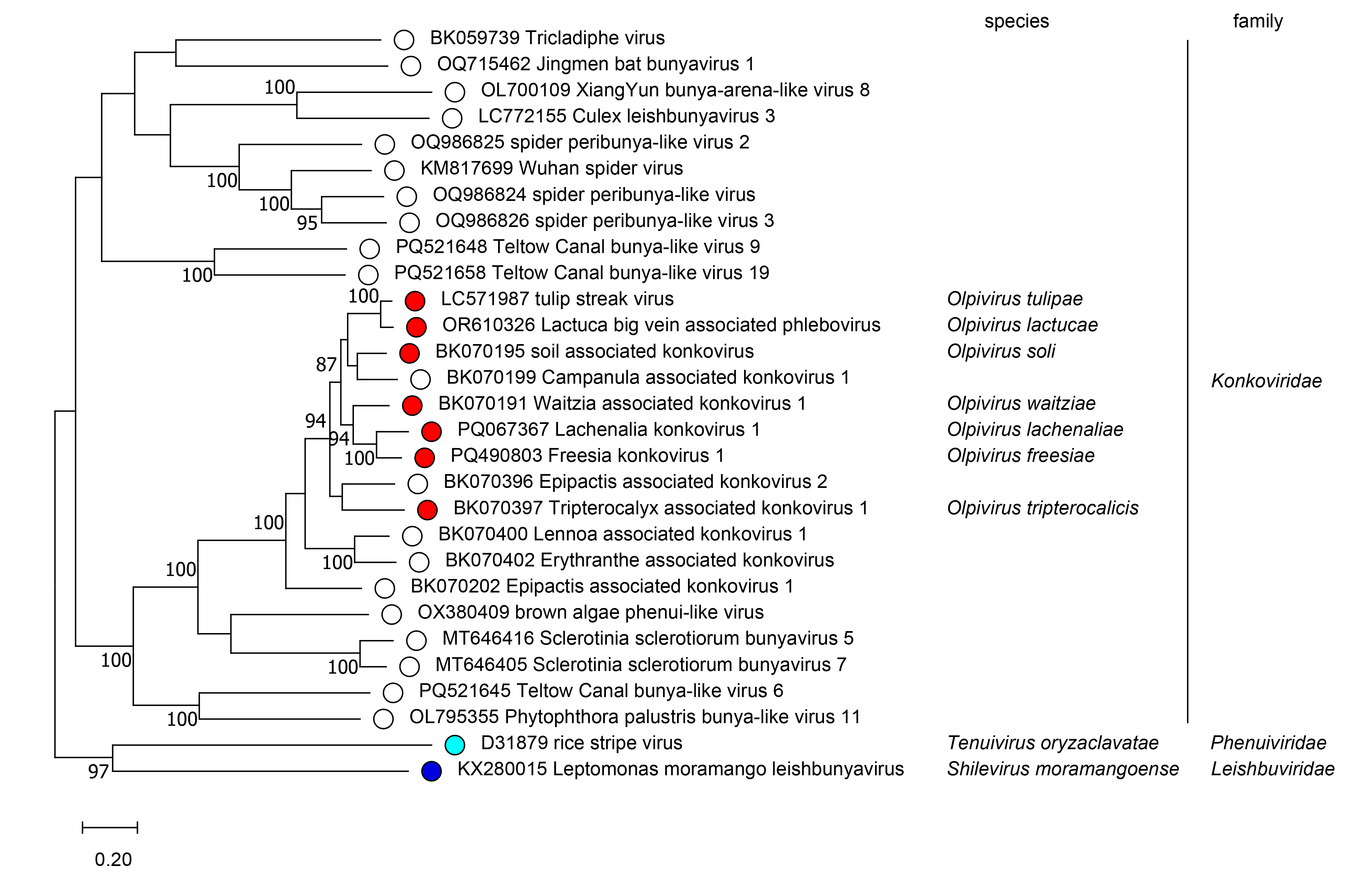 |
| Figure 3 Konkoviridae. Phylogenetic analysis of konkoviruses and the related viruses. The L amino acid sequences were aligned using MUSCLE and a maximum likelihood tree was produced using MEGA12 with default settings. Numbers at nodes indicate bootstrap support where this was > 70%. Red spots indicate viruses assigned to a species in the family Konkoviridae. Leptomonas moramango leishbunyavirus (Leishbuviridae, cyan spot, KX280015) and rice stripe virus (Phenuiviridae, blue spot, D31879) were used as outgroups. |
Relationships with other taxa
Within the order Hareavirales, konkoviruses are closely related to viruses in the families Leishbuviridae and Phenuiviridae, and more distantly related to viruses in the families Arenaviridae, Discoviridae, Mypoviridae, Nairoviridae, Tosoviridae and Wupedeviridae (Figure 4 Konkoviridae).
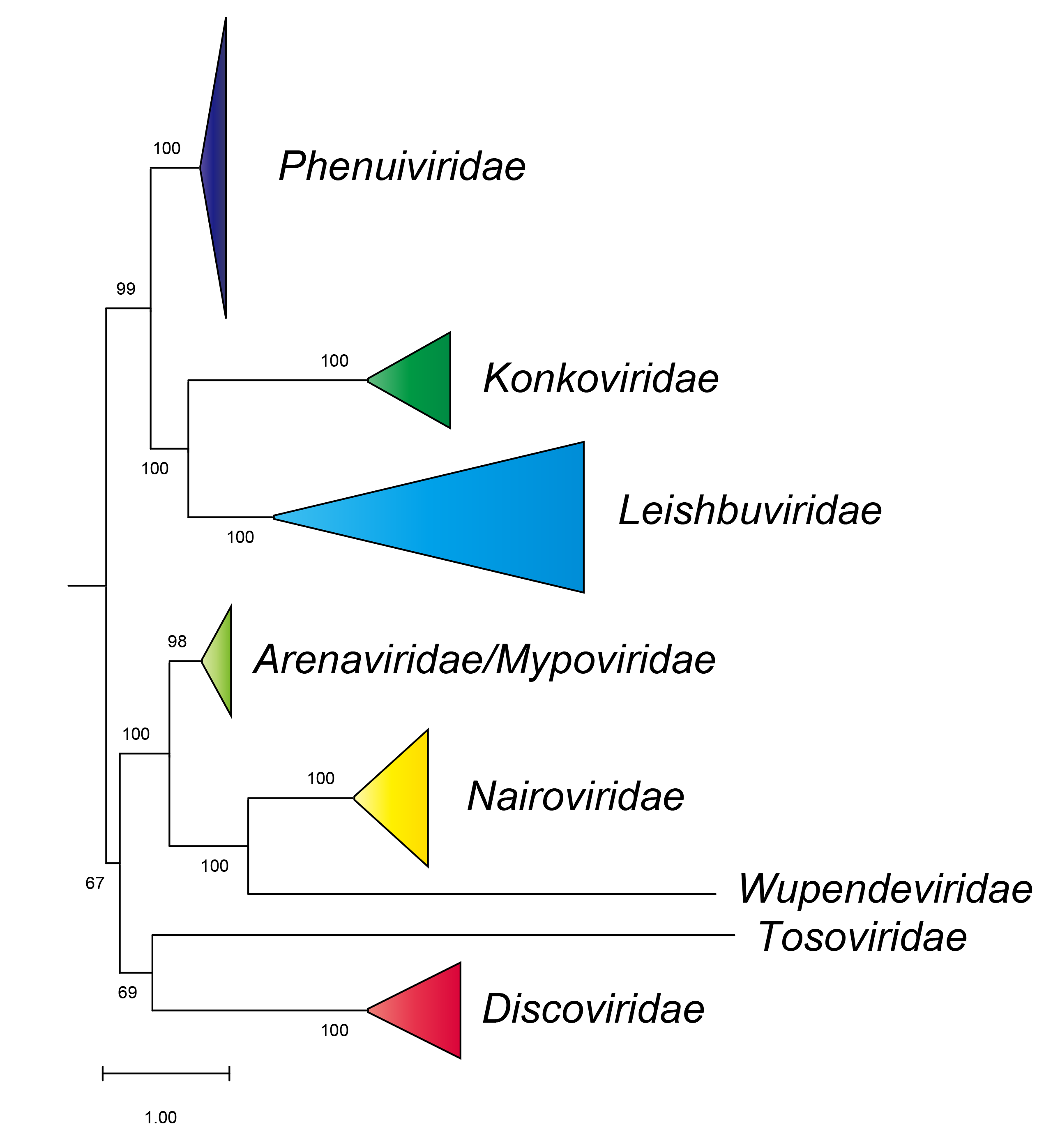 |
| Figure 4 Konkoviridae. Phylogenetic relationships of konkoviruses with other members of the order Hareavirales. The L amino acid sequences were aligned using MUSCLE and a maximum likelihood tree was produced using FastTree with default settings. Branches are collapsed at family level. Numbers at nodes indicate bootstrap support where this was > 60%. |
Related, unclassified viruses
Partial genome sequences of unclassified konkoviruses have been found in bluebell (Campanulaceae, Campanula aff. rotundifolia L.), Flor de tierra (Boraginaceae, Lennoa madreporoides Lex., 1824), lily [Liliaceae, Lilium leucanthum var. centifolium (Stapf ex Elwes) Woodcock & Coutts, 1935], orchids (Orchidaceae, Epipactis purpurata Sm., 1828), and Pennell's panther (Phrymaceae, Erythranthe pardalis G. L. Nesom, 2012) (Marra et al., 2026). Partial genome sequences have also been found in non-plant hosts such as big-footed bats (Myotis pilosus Peters, 1869) in China (Chen et al., 2023), arthropods such as southern house mosquitoes (Culex quinquefasciatus Say, 1823) in Zambia (Orba et al., 2023), Japanese encephalitis mosquitos (Culex tritaeniorhynchus Giles, 1901) in China [RNA1: OL700109]), brown sailor spider (Neoscona nautica L. Koch, 1875) (Li et al., 2015), and unspecified spiders in New Zealand (French et al., 2023), flatworms (Procotyla fluviatilis Leidy, 1857) (Dheilly et al., 2022), brown algae (Sargassum thunbergii (Mertens ex Roth) Kuntze, 1880)) in Australia (Mifsud et al., 2022), plant pathogenic fungi such as Sclerotinia sclerotiorum (Lib.) de Bary, 1884 in China (Jia et al., 2021) and oomycetes such as Phytophthora sp. in Indonesia (Botella et al., 2022). The partial genome sequences of unclassified konkoviruses have also been detected by river water metagenome analysis (Zell et al., 2024).
| Virus name | Accession number | Virus abbreviation |
| brown algae phenui-like virus | RNA1: OX380409* | BAPLV |
| Campanula associated konkovirus 1 | RNA1: BK070199*; RNA2: BK070200; RNA3: BK070201 | CaKV1 |
| Culex leishbunyavirus 3 | RNA1: LC772155* | ClLBV3 |
| Epipactis-associated konkovirus 1; Epipactis associated konkovirus 2# | RNA1: BK070202; RNA1: BK070396; RNA2: BK070203# | EpaKV1, EpaKV2# |
| Erythranthe associated konkovirus 1 | RNA1: BK070402; RNA2: BK070403 | EryaKV1 |
| Jingmen bat bunyavirus 1 | RNA1: OQ715462 | JBBV1 |
| Lachenalia phenuivirus 1 | RNA1: PQ067367; RNA2: PQ067368; RNA3: PQ067369; RNA4: PQ067370 | LacPV1 |
| Lennoa associated konkovirus 1 | RNA1: BK070400; RNA2: BK070401 | LeaKV1 |
| Phytophthora palustris bunya-like virus 11 | RNA1: OL795355; RNA2: OL795354 | PpaBLV11 |
| Sclerotinia sclerotiorum bunyavirus 5 | RNA1: MT646416* | SsBV5 |
| Sclerotinia sclerotiorum bunyavirus 7 | RNA1: MT646405* | SsBV7 |
| spider peribunya-like virus | RNA1: OQ986824 | SPLV |
| spider peribunya-like virus 2 | RNA1: OQ986825 | SPLV2 |
| spider peribunya-like virus 3 | RNA1: OQ986826 | SPLV3 |
| Teltow Canal bunya-like virus 6 | RNA1: PQ521645* | TCBLV6 |
| Teltow Canal bunya-like virus 9 | RNA1: PQ521648 | TCBLV9 |
| Teltow Canal bunya-like virus 19 | RNA1: PQ521658 | TCBLV19 |
| Tricladiphe virus | RNA1: BK059739; RNA2: BK059740 | TriV |
| Wuhan spider virus | RNA1: KM817699 | WhSV |
| XiangYun bunya-arena-like virus 8 | RNA1: OL700109 | XyBALV8 |
* Sequences do not comprise the complete genome segment.
# The RNA1 sequences of Epipactis associated konkovirus 1 and Epipactis associated konkovirus 2 were reconstructed from the same metatranscriptomic dataset, so it is not known if RNA2 belongs to EpaKV1 or EpaKV2.
Virus names and virus abbreviations are not official ICTV designations.